
Growth Engineer vs GTM Engineer: Roles Compared
Growth Engineer vs. GTM Engineer: Discover how these roles differ in responsibilities, technical skills, salaries, career paths, and business impact.
On this page
- What is a growth engineer?
- What are the core responsibilities of a growth engineer?
- What are the top difference between growth engineer vs GTM engineer?
- Organizational placement
- Why these roles are growing?
- Responsibilities compared
- What are the top growth engineer responsibilities?
- What are the top GTM engineer responsibilities?
- Skills required
- Tech stack comparison
- Measuring Success
- Salary Comparison
- Which role should your company hire?
- Career path comparison
- How AI is changing both roles?
- Conclusion
The rise of AI, automation, and product-led growth has introduced a new generation of technical business roles. Among the most talked-about are Growth Engineer and GTM (Go-to-Market) Engineer.
At first glance, the two positions appear very similar. Both combine technology with business strategy, work across multiple teams, and build systems that help companies grow. It's common to see overlapping responsibilities such as automation, data analysis, CRM management, experimentation, and AI implementation.
However, their primary objectives are different.
A Growth Engineer focuses on accelerating user acquisition, activation, engagement, and retention by building experiments and optimizing the product growth funnel.
A GTM Engineer focuses on designing and maintaining the technology, automation, and AI infrastructure that powers marketing, sales, customer success, and the broader revenue organization.
As companies invest in Revenue Operations, AI agents, and increasingly sophisticated GTM technology, understanding the distinction between these roles has become important for hiring managers, founders, and professionals planning their careers.
Whether you're evaluating job opportunities or building a modern revenue team, this comparison will help clarify where each role delivers the most value.
What is a growth engineer?
A Growth Engineer is a technical professional responsible for improving business growth through experimentation, product optimization, automation, and data-driven decision-making.
Growth Engineers typically work at the intersection of:
- Product
- Engineering
- Marketing
- Analytics
- Growth teams
Their primary mission is to help companies acquire more users, improve product activation, increase retention, and maximize customer lifetime value.
Instead of focusing on traditional software development, Growth Engineers build systems and experiments that directly influence growth metrics.
Typical projects include:
- Building onboarding experiments
- Improving signup conversion rates
- Creating referral systems
- Implementing A/B tests
- Automating growth campaigns
- Tracking user behavior
- Improving product activation
- Optimizing conversion funnels
Every initiative is measured by its impact on business growth.
What are the core responsibilities of a growth engineer?
Growth Engineers commonly:
- Build experimentation frameworks
- Launch A/B tests
- Improve conversion funnels
- Analyze user behavior
- Optimize onboarding flows
- Create product growth automation
- Implement analytics events
- Improve retention strategies
- Support Product-Led Growth (PLG)
- Develop internal growth tools
Success is measured by improvements in user acquisition, activation, engagement, and retention.
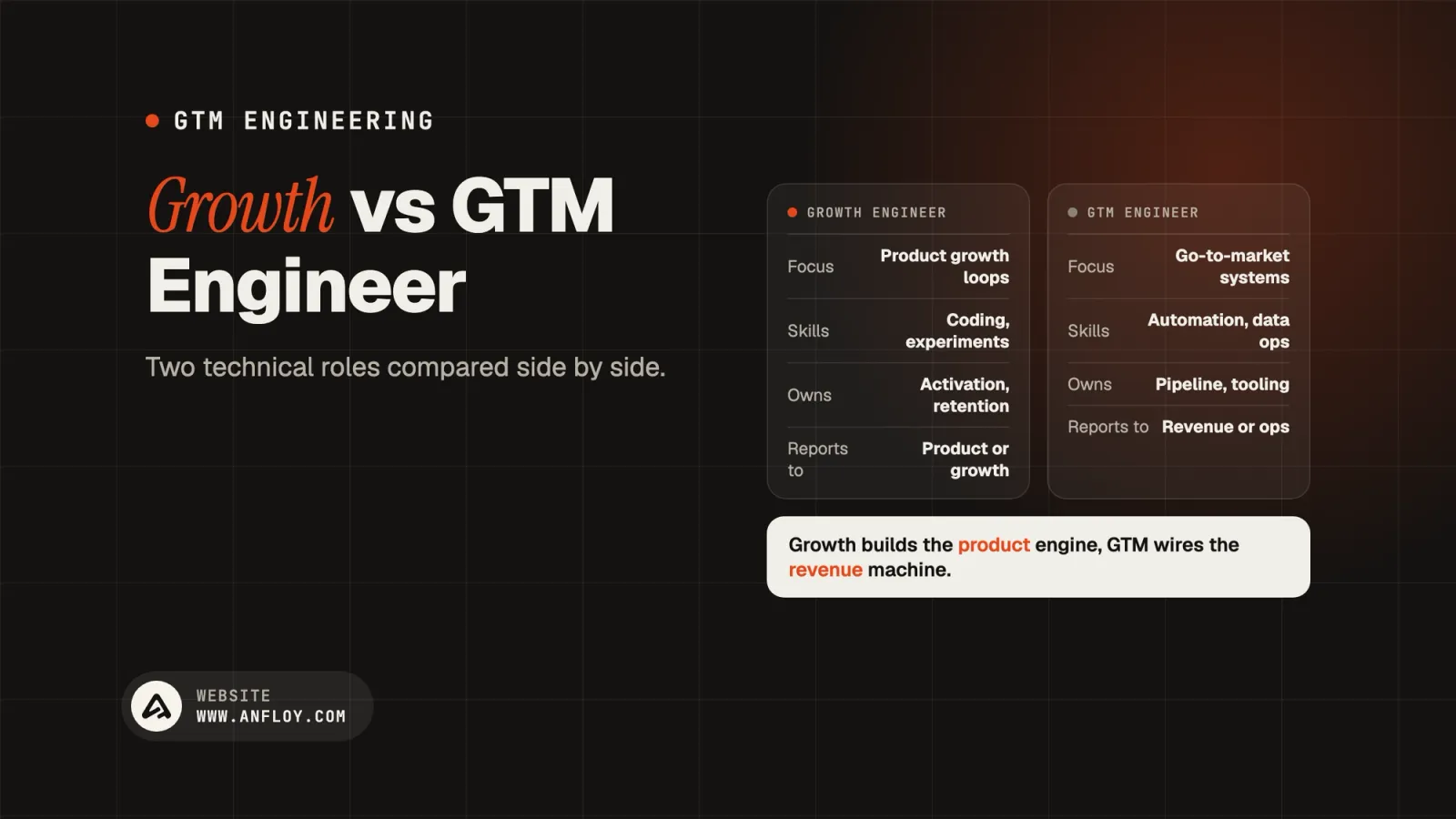
What are the top difference between growth engineer vs GTM engineer?
Although both roles require technical skills and systems thinking, their objectives differ significantly.
| Category | Growth Engineer | GTM Engineer |
|---|---|---|
| Primary Goal | Accelerate product growth | Scale revenue operations |
| Main Focus | User acquisition and retention | Marketing, sales, and customer success systems |
| Department | Product / Growth | Revenue Operations / GTM |
| Success Metrics | Activation, retention, conversion | Pipeline, automation, operational efficiency |
| Primary Users | Product teams | Revenue teams |
| Technology Focus | Product analytics and experimentation | CRM, automation, integrations, AI |
| AI Usage | Personalization and experimentation | Revenue workflows and AI agents |
| Daily Work | Experiments and product optimization | Automation and revenue infrastructure |
| Business Impact | Product growth | Revenue scalability |
Although they solve different problems, both roles contribute to sustainable business growth.
Organizational placement
Most companies position these roles in different parts of the organization.
CEO
                      │
      ┌───────────────┴───────────────┐
      │                               │
 Product & Growth                 Revenue Organization
      │                               │
Growth Engineer                 GTM Engineer
      │                               │
 Product Teams        Marketing • Sales • Customer Success
Growth Engineers improve the product experience.
GTM Engineers improve the systems supporting the customer journey after demand generation and throughout the revenue lifecycle.
Why these roles are growing?
Several industry trends have accelerated demand for both Growth Engineers and GTM Engineers.
These include:
- Artificial intelligence
- Product-Led Growth
- Revenue Operations
- Low-code automation
- API-first software
- Customer data platforms
- Increasing SaaS adoption
The difference lies in where these technologies are applied.
Growth Engineers use them to improve product adoption and engagement.
GTM Engineers use them to improve operational efficiency, revenue generation, and customer lifecycle management.
Responsibilities compared
Although Growth Engineers and GTM Engineers both solve business problems using technology, their day-to-day responsibilities differ considerably.
A simple way to understand the distinction is this:
- Growth Engineers optimize how customers adopt and use the product.
- GTM Engineers optimize how the business acquires, manages, and serves customers through scalable revenue systems.
Let's explore their responsibilities in more detail.
What are the top growth engineer responsibilities?
Growth Engineers focus on improving every stage of the product growth funnel.
Their work is highly experimental and data-driven.
Typical responsibilities include:
- Designing A/B experiments
- Improving signup conversion rates
- Optimizing onboarding experiences
- Building referral systems
- Tracking product analytics
- Improving feature adoption
- Creating growth automation
- Analyzing user behavior
- Working with product managers
- Supporting Product-Led Growth (PLG)
A Growth Engineer spends much of the day asking questions like:
- Why are users dropping off?
- Which onboarding flow converts better?
- Which feature drives long-term retention?
- How can activation happen faster?
Every project is tied to measurable growth metrics.
What are the top GTM engineer responsibilities?
GTM Engineers focus on building the infrastructure that powers the revenue organization.
Their work emphasizes automation, integration, and operational scalability.
Typical responsibilities include:
- Designing CRM architecture
- Building workflow automation
- Connecting SaaS platforms
- Creating API integrations
- Managing customer data
- Automating lead routing
- Deploying AI agents
- Implementing Revenue Intelligence
- Building reporting systems
- Maintaining revenue infrastructure
Instead of asking how to increase product engagement, GTM Engineers ask:
- How can we automate lead routing?
- How can CRM data stay synchronized?
- How can AI reduce manual work?
- How can marketing and sales systems communicate seamlessly?
Their focus is on operational excellence rather than product optimization.
Skills required
Although both careers require technical curiosity and systems thinking, the skill sets emphasize different areas.
Growth Engineer Skills
Technical skills
Growth Engineers should understand:
- Product analytics
- SQL
- JavaScript basics
- Experimentation platforms
- Feature flagging
- Event tracking
- API integrations
- Data visualization
Business skills
Important business knowledge includes:
- Product-Led Growth (PLG)
- User acquisition
- Customer retention
- Conversion optimization
- Customer behavior
- Marketing funnels
Soft Skills
Successful Growth Engineers develop:
- Curiosity
- Experimentation mindset
- Analytical thinking
- Creativity
- Problem solving
- Collaboration
Growth work is iterative, requiring constant testing and refinement.
GTM engineer skills
Technical Skills
Key technical competencies include:
- CRM administration
- CRM architecture
- Workflow automation
- APIs
- Webhooks
- AI implementation
- Data synchronization
- Revenue systems
- SQL fundamentals
- Reporting automation
Business skills
GTM Engineers benefit from understanding:
- Revenue Operations
- Sales Operations
- Marketing Operations
- Customer Success
- Sales funnels
- Pipeline management
- SaaS metrics
- Customer lifecycle
Soft skills
Highly effective GTM Engineers excel at:
- Systems thinking
- Documentation
- Cross-functional communication
- Process design
- Problem solving
- Continuous learning
Because GTM Engineers work across multiple departments, communication is just as valuable as technical expertise.
Tech stack comparison
The tools used by Growth Engineers and GTM Engineers often overlap, but their use cases are very different.
| Technology | Growth Engineer | GTM Engineer |
|---|---|---|
| HubSpot | Limited | Core platform |
| Salesforce | Occasionally | Core platform |
| Google Analytics 4 | Product and marketing analytics | Attribution and reporting |
| Mixpanel | Core analytics platform | Occasionally |
| Amplitude | Core analytics platform | Occasionally |
| LaunchDarkly | Feature flags and experimentation | Rare |
| Optimizely | A/B testing | Rare |
| Zapier | Basic automation | Advanced automation |
| n8n | Internal workflows | Revenue orchestration |
| Make | Campaign automation | Multi-system workflows |
| Segment | Customer event tracking | Customer data synchronization |
| Clay | Rare | Lead enrichment |
| Apollo | Limited | Sales engagement |
| ChatGPT | Experiment design | AI workflows |
| Claude | Analysis | AI automation |
| Gemini | Research | Revenue workflows |
Growth Engineers spend more time with product analytics and experimentation platforms.
GTM Engineers spend more time with CRM platforms, automation software, and revenue technology.
Measuring Success
The metrics used to evaluate each role also differ significantly.
Growth engineer KPIs
Growth Engineers commonly track:
- Visitor-to-signup conversion
- Product activation rate
- Trial-to-paid conversion
- Daily Active Users (DAU)
- Monthly Active Users (MAU)
- Feature adoption
- User retention
- Churn reduction
- Customer Lifetime Value (LTV)
Every initiative is evaluated based on its effect on product growth.
GTM engineer KPIs
GTM Engineers typically measure:
- Lead response time
- CRM data quality
- Workflow success rate
- Automation coverage
- Pipeline velocity
- Revenue attribution accuracy
- Lead routing efficiency
- System uptime
- API reliability
- Operational efficiency
Their focus is on building systems that enable revenue teams to operate more effectively.
Salary Comparison
Both roles are well compensated because they combine technical skills with business impact.
Approximate annual salary ranges in the United States are shown below.
| Experience | Growth Engineer | GTM Engineer |
|---|---|---|
| Entry Level | $85,000–$115,000 | $90,000–$120,000 |
| Mid-Level | $120,000–$170,000 | $140,000–$190,000 |
| Senior | $170,000–$240,000+ | $190,000–$300,000+ |
While salary depends on company size, industry, and location, GTM Engineering often commands a premium due to increasing demand for AI implementation, workflow automation, and revenue systems expertise.
Which role should your company hire?
Choosing between a Growth Engineer and a GTM Engineer depends on your organization's biggest challenge.
Hire a growth engineer if you need to:
- Increase product adoption
- Improve onboarding
- Reduce churn
- Run A/B experiments
- Optimize activation
- Improve Product-Led Growth
- Increase feature usage
Growth Engineers are ideal when product growth is your primary objective.
Hire a GTM engineer if you need to:
- Modernize CRM systems
- Automate revenue workflows
- Connect multiple business applications
- Improve lead routing
- Implement AI agents
- Improve sales efficiency
- Build scalable Revenue Operations
GTM Engineers are the better choice when operational efficiency and revenue scalability are limiting growth.
Growing companies often need both
As organizations mature, these roles become complementary.
A common division of responsibilities looks like this:
Growth Engineer
- Product experimentation
- Conversion optimization
- User analytics
- Activation
- Retention
GTM Engineer
- CRM
- Revenue automation
- AI implementation
- Workflow orchestration
- Customer lifecycle automation
Together, they improve both the product experience and the operational systems supporting the business.
Career path comparison
Both careers offer excellent long-term opportunities but evolve in different directions.
Growth engineering career path
Growth Analyst
      │
      ▼
Junior Growth Engineer
      │
      ▼
Growth Engineer
      │
      ▼
Senior Growth Engineer
      │
      ▼
Head of Growth Engineering
      │
      ▼
VP Growth
GTM engineering career path
Revenue Operations Associate
          │
          ▼
Junior GTM Engineer
          │
          ▼
GTM Engineer
          │
          ▼
Senior GTM Engineer
          │
          ▼
Head of GTM Engineering
          │
          ▼
VP Revenue Operations
Growth Engineering typically progresses toward product and growth leadership.
GTM Engineering often leads toward Revenue Operations and go-to-market leadership.
How AI is changing both roles?
Artificial intelligence is transforming Growth Engineering and GTM Engineering, but in different ways.
AI in growth engineering
Growth Engineers increasingly use AI to:
- Personalize onboarding
- Recommend features
- Predict churn
- Generate experiment ideas
- Analyze user behavior
- Optimize pricing strategies
AI enables faster experimentation and more personalized product experiences.
AI in GTM engineering
GTM Engineers use AI to:
- Build autonomous workflows
- Create AI-powered lead qualification
- Automate CRM updates
- Deploy Company AI Brains
- Implement Revenue Intelligence
- Orchestrate AI agents across business systems
AI is becoming a foundational layer of modern GTM Engineering.
Conclusion
Growth Engineers and GTM Engineers share a passion for solving business problems through technology, but they optimize different parts of the customer journey.
Growth Engineers focus on improving product adoption, experimentation, and user engagement.
GTM Engineers focus on building the automation, CRM architecture, integrations, and AI systems that power scalable revenue growth.
Rather than competing, these roles complement one another. Organizations that invest in both can optimize product growth while creating efficient, AI-powered revenue operations capable of supporting long-term success.
Talk to Anfloy
Modern revenue growth depends on more than great products it requires intelligent systems that connect marketing, sales, customer success, and AI.
Anfloy helps businesses design scalable GTM Engineering solutions through CRM architecture, workflow automation, AI implementation, Revenue Intelligence, and connected go-to-market systems.
Frequently Asked Questions
Is a Growth Engineer the same as a GTM Engineer?
No. Growth Engineers focus on product growth, user acquisition, activation, and retention. GTM Engineers focus on revenue operations, CRM architecture, workflow automation, AI implementation, and the systems supporting marketing, sales, and customer success.
Which role pays more?
Both careers offer competitive salaries, but GTM Engineering often has slightly higher earning potential because of its deep involvement with enterprise systems, automation, and AI.
Can a Growth Engineer transition into GTM Engineering?
Yes. Growth Engineers already possess strong technical and analytical skills. By learning CRM platforms, Revenue Operations, workflow automation, and AI-driven revenue systems, they can successfully move into GTM Engineering.
Which career has better long-term prospects?
Both fields are expected to continue growing. Growth Engineering remains critical for product-led businesses, while GTM Engineering is seeing rapid demand across SaaS and B2B organizations adopting AI and advanced revenue operations.
Do startups need both roles?
Not necessarily. Product-led startups often hire a Growth Engineer first, while sales-led organizations may benefit more from a GTM Engineer. As companies scale, many eventually employ both roles.
Let's build
what your
company needs.
Drop your email. We'll send The Custom Agent Blueprint on what we'd build first for a company like yours, before you ever take a meeting.