
GTM Data Infrastructure: The Foundation Every GTM System Actually Depends On
GTM data infrastructure is the layer beneath every workflow, score, and AI agent in a revenue org. Learn what it actually consists of, the signs it's broken, and how to build it in stages.
On this page
- What is GTM data infrastructure?
- The layers that make up GTM data infrastructure
- Signs your GTM data infrastructure is the real bottleneck
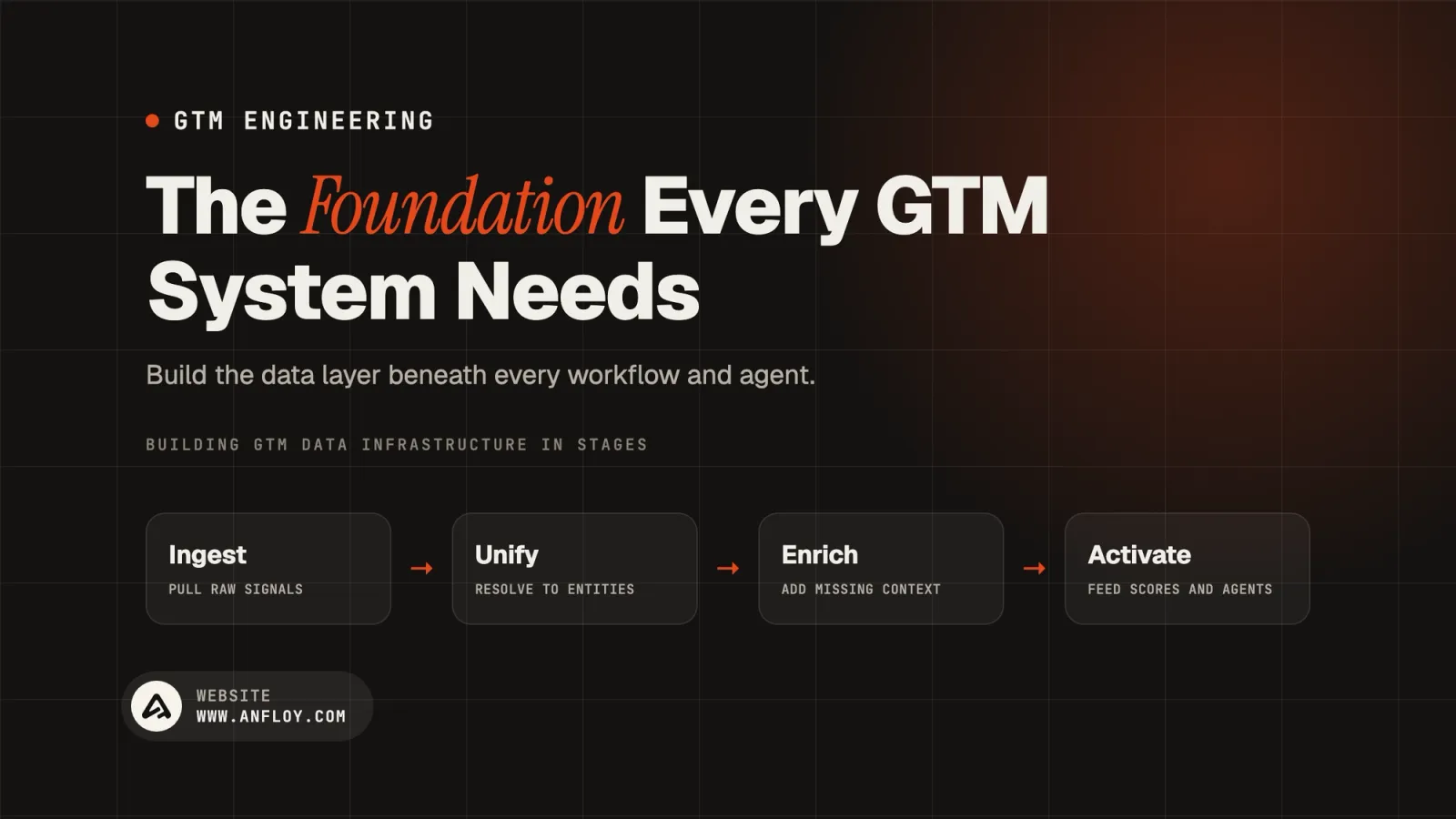
- Building GTM data infrastructure in stages
- GTM data infrastructure and AI: Why the stakes just went up
- Common mistakes in building GTM data infrastructure
- How Anfloy builds GTM data infrastructure?
- Conclusion
Every broken GTM system eventually traces back to the same root cause, and it's rarely the workflow logic itself. A lead routing rule that looks correct fails because the account field it's checking is inconsistently populated.
A scoring model trained carefully still produces bad scores because the firmographic data feeding it is stale. An AI agent generating personalized outreach sounds generic because the account context it's drawing from is thin or contradictory across systems.
None of these are workflow problems. They're data infrastructure problems wearing a workflow costume. GTM data infrastructure is the layer beneath everything else in a revenue organization, and it's the layer most companies invest in last, after the visible symptoms, bad routing, weak personalization, unreliable forecasts, have already cost them real pipeline.
This guide covers what GTM data infrastructure actually consists of, the signs a company's infrastructure is the real bottleneck, and how to build it in stages rather than as one overwhelming project.
What is GTM data infrastructure?
GTM data infrastructure is the set of systems and processes that capture, store, clean, connect, and deliver the data every revenue workflow depends on, the layer that determines whether a CRM field is accurate, whether an enrichment lookup returns something useful, and whether an AI agent reasoning about an account is working from a complete picture or a fragmented one.
It's distinct from the GTM tech stack, though the two are closely related. The tech stack is the set of tools, a CRM, an enrichment provider, a sequencing platform.
Data infrastructure is what determines whether those tools are actually working from the same facts or quietly drifting apart, each holding its own partial, inconsistent version of the truth.
The layers that make up GTM data infrastructure
Regardless of a company's specific tools, GTM data infrastructure breaks down into the same functional layers, each with a distinct job.
Source systems
Where data originates: the CRM, the product itself, marketing automation, support tickets, billing.
Every one of these systems generates data relevant to the GTM motion, often without the other systems being aware it exists.
Ingestion and movement
The pipelines that move data from source systems into a central location, and the mechanism, batch, real-time, event-based, that determines how current that data actually is by the time anything downstream uses it.
A pipeline that syncs once a day makes same-day signal-based outreach effectively impossible, regardless of how good the workflow logic built on top of it is.
Storage and modeling
Where data lands and how it's structured once it arrives, typically a data warehouse, with a defined schema that represents accounts, contacts, and events consistently rather than however each source system happened to structure them originally.
This is the layer that turns raw, disconnected data into something a workflow or an AI agent can actually reason about reliably.
Identity resolution
The logic that determines which records across different systems refer to the same actual person or account.
Without this, a company can have five different records for the same contact scattered across systems, none of them fully accurate, none of them recognized as duplicates.
Enrichment and augmentation
Where third-party and first-party data, firmographics, technographics, buying signals, gets appended to the core dataset, the layer covered in depth in AI for CRM data enrichment and central to what makes an account record useful rather than just a name and a domain.
Activation
The mechanism that gets modeled, enriched data back out to the tools people actually work in, the CRM, the sales engagement platform, an AI agent's context window, rather than leaving it stranded in a warehouse only a BI dashboard ever touches.
Governance
Access control, data quality monitoring, and an audit trail of what changed, when, and why. This is the layer most commonly skipped, and it's almost always the reason a well-built infrastructure quietly degrades a year after launch with no one noticing until something visibly breaks.
Signs your GTM data infrastructure is the real bottleneck
Weak data infrastructure rarely announces itself directly. It shows up as symptoms in workflows and tools that look, on the surface, like a different kind of problem entirely.
- The same account looks different depending on which tool you check. If the CRM, the enrichment tool, and the BI dashboard disagree about basic facts on the same account, there's no actual source of truth, regardless of how many tools are technically connected.
- Personalization reads as generic despite an AI tool that's supposed to be smart. An AI agent is only as good as the context it can retrieve. Thin or fragmented data produces thin, generic output no matter how capable the underlying model is.
- Reps don't trust the CRM enough to rely on it. Once a sales team starts keeping its own spreadsheets or private notes because the CRM is unreliable, the infrastructure problem has already become a culture problem, which is considerably harder to unwind.
- Reports from different teams don't match for the same metric. If marketing's pipeline number and sales' pipeline number for the same period are meaningfully different, they're very likely drawing from different, disconnected versions of the underlying data.
- New tool adoption keeps creating more silos instead of solving problems. Every new point tool added to compensate for a data gap tends to become its own island, holding yet another partial copy of the same customer data, compounding the fragmentation rather than fixing it.
If more than one or two of these sound familiar, the actual bottleneck usually isn't the workflow, the AI model, or the sales process. It's the data infrastructure underneath all three.
Building GTM data infrastructure in stages
Building this correctly doesn't require a large, multi-quarter overhaul before any value shows up.
A staged approach produces usable results early while still building toward something durable.
Stage one: establish a single source of truth for core objects.
Before anything else, define which system is authoritative for account, contact, and deal data, and resolve the identity conflicts between systems holding conflicting versions of the same records.
Stage two: connect ingestion for the data that matters most right now.
Rather than piping in every possible data source at once, start with whatever feeds the highest-priority use case, product usage data if you're building signal-based outbound, support data if you're building churn risk detection.
Stage three: build the enrichment and modeling layer around a specific workflow.
Rather than enriching everything speculatively, build the enrichment pipeline to serve a defined use case first, so its value is measurable rather than abstract.
Stage four: wire activation back into the tools people actually use.
A clean, modeled dataset sitting only in a warehouse doesn't help a rep or an AI agent. Reverse ETL or direct API integration back into the CRM and outreach tools is what makes the infrastructure operational rather than just analytical.
Stage five: add governance once there's something worth governing.
Access controls and audit trails matter more once multiple tools and multiple people are actively writing back into the shared data layer, which usually happens naturally by this stage rather than needing to be forced earlier.
This sequencing mirrors the same logic covered in GTM engineering use cases: foundational work first, in service of one real use case, rather than infrastructure built speculatively ahead of any actual demand for it.
Want to know exactly where your data infrastructure is breaking down? Get a free AI infrastructure audit and we'll map it against your real stack.
GTM data infrastructure and AI: Why the stakes just went up
The cost of weak data infrastructure has always been real, misrouted leads, inaccurate forecasts, wasted rep time.
AI agents raise the stakes considerably, because an agent making an autonomous decision, qualifying a lead, flagging a deal at risk, generating outreach, is only as reliable as the data it's reasoning from.
A workflow with a data gap produces an obviously wrong CRM field a human can catch and fix.
An AI agent with the same data gap can produce a confident, plausible-sounding output that's subtly wrong, which is considerably harder to catch before it reaches a prospect or a rep acts on it.
This is the same reasoning behind why a company AI brain depends on the data infrastructure underneath it being solid first. No amount of prompt engineering or model capability compensates for an agent reasoning from fragmented, inconsistent source data, and teams that invest in AI agents before shoring up the infrastructure underneath them tend to get confident-sounding but unreliable output rather than the leverage they were expecting.
Common mistakes in building GTM data infrastructure
Buying tools before defining the data model underneath them.
A new enrichment tool or AI agent platform doesn't fix fragmented data, it just adds another consumer of that fragmented data, and often another source of it too.
Treating infrastructure as a one-time project instead of an ongoing discipline.
Source systems change, new tools get added, teams reorganize. Infrastructure that isn't actively maintained drifts out of alignment with the business it's meant to serve, quietly, without triggering an obvious error.
Building for every possible use case before proving value on one.
Speculative infrastructure built ahead of a defined use case is difficult to justify and, more importantly, difficult to know is actually correct, since there's no real workflow yet testing whether the data model holds up.
Skipping identity resolution and hoping enrichment fixes it.
Enrichment adds more data to a record; it doesn't resolve whether that record and another one in a different system are actually the same account. Without identity resolution, enrichment just makes the fragmentation more detailed.
No one accountable for data quality specifically.
Data quality tends to fall into the gap between IT, RevOps, and whichever team happens to notice a problem first.
Without a named owner, the same gap covered in GTM workflows more broadly, infrastructure decays the same way an unowned workflow does.
How Anfloy builds GTM data infrastructure?
Anfloy treats data infrastructure as the foundation every other GTM system we build depends on, not an afterthought layered in once a workflow or an AI agent is already underperforming.
We design the source-to-activation pipeline around a specific, prioritized use case first, whether that's a composable data architecture spanning multiple tools or a more focused enrichment and identity resolution layer for a narrower need, and build outward from there rather than attempting to solve every data problem in a company at once.
Every system is deployed on infrastructure you own outright, with the data model, pipelines, and governance documented clearly enough that the next system built on top of it, whether by us or by your own team, inherits a solid foundation instead of more fragmentation.
Not sure whether your infrastructure needs a rebuild or targeted fixes? See how our process works before scoping anything.
Conclusion
GTM data infrastructure is the layer most companies notice last and need most.
Every workflow, every score, every AI agent reasoning about an account is only as good as the data feeding it, and no amount of clever workflow design or capable AI compensates for a fragmented, inconsistent foundation underneath.
The companies getting real leverage from their GTM systems aren't the ones with the most tools, they're the ones who solved the data layer first and built everything else on top of something solid.
Ready to find out what your data infrastructure actually needs? Book a call, no decks, no demos, just a working session on where to start.
Frequently Asked Questions
What's the difference between GTM data infrastructure and a GTM tech stack?
The tech stack is the set of tools a revenue organization uses. Data infrastructure is what determines whether those tools are actually working from the same, accurate, current data or quietly drifting into disconnected silos. A company can have an impressive tech stack and still have weak data infrastructure underneath it.
Do we need a data warehouse to have real GTM data infrastructure?
For most companies past a certain scale, effectively yes, since a warehouse is what makes a genuine single source of truth possible rather than each tool holding its own partial copy of the data. Smaller teams with a very simple stack can sometimes get by without one, but the need tends to appear quickly as tools and data sources multiply.
How do we know if our data infrastructure is actually the problem?
Look for the symptoms rather than assuming the workflow or the tool is at fault: inconsistent account data across systems, generic-feeling AI output despite a capable model, reports that don't match between teams, and reps who've stopped trusting the CRM enough to rely on it. These are infrastructure symptoms even when they show up as a workflow or personalization complaint.
How long does it take to build solid GTM data infrastructure?
A focused first stage, resolving identity conflicts and establishing a source of truth for core objects, tied to one specific use case, is often achievable in a matter of weeks. Building out the full stack across every data source and use case is an ongoing process measured in quarters, not a single project with a fixed end date.
Is this only relevant for large enterprises with complex data estates?
No, though the pain shows up first and most visibly at that scale. Smaller companies running lean stacks often get by without dedicated infrastructure work for a while, but the moment they add a second or third tool that needs to share account data reliably, the same fragmentation problems start appearing regardless of company size.
Let's build
what your
company needs.
Drop your email. We'll send The Custom Agent Blueprint on what we'd build first for a company like yours, before you ever take a meeting.