
How to Hire a GTM Engineer in 2026: Complete Guide
Learn how to hire a GTM Engineer in 2026. Explore key skills, interview questions, salary factors, hiring steps, and when your business needs one.
On this page
- Why companies are hiring GTM engineers in 2026
- What does a GTM engineer do?
- When to hire a GTM engineer
- Where to source GTM engineer candidates?
- When should you hire a GTM engineer?
- GTM engineer vs similar roles
- How GTM engineers fit inside the revenue organization?
- Define the business problem before hiring
- What Skills Should Every GTM Engineer Have?
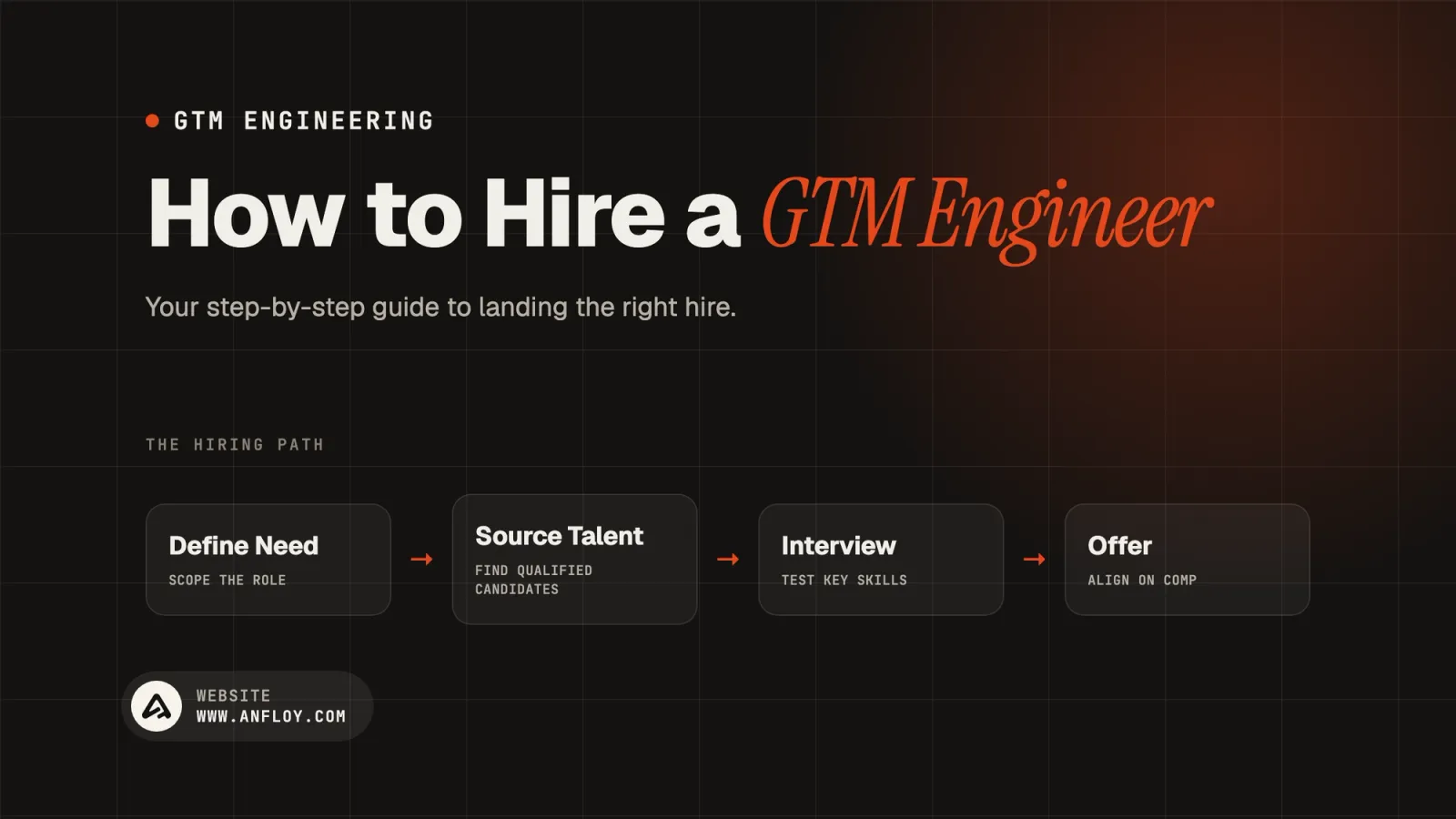
- What Is the Step-by-Step GTM Engineer Hiring Process?
- What Are the Most Common GTM Engineer Interview Questions?
- What Are the Red Flags During the Hiring Process?
- Should you hire an in-house GTM engineer or work with an agency?
- Building a GTM engineering team
- GTM engineer salary and hiring factors
- Onboarding a GTM engineer successfully
- First 90-day roadmap
- How to measure GTM engineer performance?
- What hiring mistakes do companies often make?
- Ignoring cultural fit
- Why businesses choose Anfloy?
- Conclusion
Hiring a great salesperson or marketer is no longer enough to build a modern revenue organization.
Today's go-to-market teams rely on CRM platforms, workflow automation, AI, Revenue Operations, customer data, API integrations, and dozens of connected applications. As this operational complexity increases, organizations need someone who can design, maintain, and optimize the systems powering the entire revenue engine.
That person is a GTM Engineer.
The demand for GTM Engineers has grown rapidly because businesses are shifting from manual, department-based operations to AI-enabled, automated revenue systems. Instead of simply configuring software, GTM Engineers connect strategy, technology, customer data, and operational workflows into a scalable infrastructure.
However, hiring a GTM Engineer isn't the same as hiring a CRM administrator, RevOps manager, Sales Operations specialist, or automation consultant.
The role requires a unique combination of technical expertise, systems thinking, business understanding, and operational execution.
Why companies are hiring GTM engineers in 2026
Revenue organizations have become significantly more complex.
A modern B2B company often operates with:
- CRM platforms
- Marketing automation
- Sales engagement software
- AI assistants
- Data enrichment platforms
- Revenue Intelligence tools
- Customer Success platforms
- Workflow automation
- Product analytics
- API integrations
Every new platform increases operational complexity.
Without dedicated ownership, businesses often experience:
- Manual processes
- Duplicate customer records
- Poor CRM adoption
- Disconnected reporting
- AI implementation challenges
- Inconsistent customer journeys
- Slower revenue growth
Hiring a GTM Engineer allows organizations to solve these problems before they become barriers to scale.
What does a GTM engineer do?
A GTM Engineer designs, builds, and optimizes the technical systems supporting go-to-market execution.
Rather than owning one department, they connect marketing, sales, customer success, and Revenue Operations through scalable operational infrastructure.
Typical responsibilities include:
- CRM architecture
- Workflow automation
- API integrations
- Revenue Operations implementation
- AI workflow design
- Customer lifecycle automation
- Data enrichment
- Revenue Intelligence
- Sales enablement systems
- Operational documentation
Their objective is to reduce operational friction while improving revenue performance.
When to hire a GTM engineer
Hiring a GTM Engineer too early can increase costs, while hiring too late often slows revenue growth.
The right timing depends on operational complexity rather than company size.
Consider hiring a GTM Engineer when your business experiences one or more of the following:
- Your CRM has become difficult to manage.
- Marketing, sales, and customer success use disconnected systems.
- Manual work is consuming significant operational time.
- Lead routing and qualification are inconsistent.
- AI initiatives require structured customer data.
- Workflow automation spans multiple departments.
- Revenue forecasting has become unreliable.
- Leadership lacks confidence in operational reporting.
- New GTM tools are being added faster than they can be integrated.
- Your Revenue Operations team spends more time fixing systems than improving them.
For early-stage startups, a GTM Engineering agency or fractional GTM Engineer may provide the fastest path to implementation. As operational complexity grows, building an internal GTM Engineering function often becomes the better long-term investment.
Where to source GTM engineer candidates?
Because GTM Engineering is an emerging discipline, exceptional candidates rarely come from one traditional career path.
Many successful GTM Engineers previously worked in Revenue Operations, Sales Operations, Marketing Operations, CRM Engineering, Solutions Engineering, or Automation Engineering before expanding into broader go-to-market systems.
Effective places to source candidates include:
Professional networks
- Industry communities
- GTM-focused Slack groups
- RevOps communities
- GTM Engineering communities
Professionals who actively share CRM, automation, AI, and Revenue Operations knowledge often demonstrate strong systems thinking.
Specialized job platforms
Post roles on platforms that attract technical go-to-market professionals rather than general job boards.
Look for candidates with experience in:
- CRM architecture
- Workflow automation
- API integrations
- Revenue Operations
- AI implementation
- GTM Engineering
Internal talent
Many organizations already employ people capable of growing into GTM Engineering roles.
Potential candidates include:
- Revenue Operations Managers
- Sales Operations Specialists
- Marketing Operations Managers
- CRM Administrators
- Automation Engineers
- Solutions Engineers
With the right mentoring and ownership, these professionals often transition successfully into GTM Engineering.
GTM engineering agencies
If you need immediate expertise or are still validating the role, partnering with a GTM Engineering agency can be more effective than recruiting a full-time employee.
Agencies provide access to multidisciplinary specialists across:
- GTM strategy
- GTM Engineering
- CRM architecture
- Revenue Operations
- AI implementation
- Workflow automation
- Data enrichment
This approach helps businesses accelerate implementation while evaluating whether an internal GTM Engineering team is needed later.
When should you hire a GTM engineer?
Not every business needs a dedicated GTM Engineer immediately.
However, several indicators suggest the role has become necessary.
You should consider hiring when:
- CRM complexity continues increasing
- Manual operational work consumes significant time
- Marketing and sales systems become disconnected
- AI initiatives begin expanding
- Customer data quality declines
- Revenue Operations becomes difficult to manage
- Workflow automation grows across multiple departments
- Forecasting lacks consistency
- Leadership lacks operational visibility
These challenges often indicate that operational systems require dedicated ownership.
GTM engineer vs similar roles
Understanding adjacent roles prevents hiring the wrong person.
| Role | Primary Focus |
|---|---|
| GTM Engineer | Revenue systems, CRM architecture, AI, automation, integrations |
| RevOps Manager | Revenue governance, forecasting, reporting, operational alignment |
| CRM Administrator | CRM configuration and maintenance |
| Sales Operations | Sales process optimization |
| Marketing Operations | Marketing technology and campaign execution |
| Automation Engineer | Workflow automation across business systems |
Although these roles overlap, a GTM Engineer combines strategic understanding with technical implementation across the entire go-to-market ecosystem.
How GTM engineers fit inside the revenue organization?
Rather than working in isolation, GTM Engineers connect every customer-facing function.
Business Strategy
        │
        ▼
Go-to-Market Strategy
        │
        ▼
GTM Engineer
        │
        ├── CRM Architecture
        ├── Workflow Automation
        ├── Revenue Operations
        ├── AI Systems
        ├── API Integrations
        ├── Data Enrichment
        ├── Revenue Intelligence
        └── Customer Lifecycle
        │
        ▼
Marketing • Sales • Customer Success
        │
        ▼
Revenue Growth
Instead of replacing existing teams, the GTM Engineer enables them to work more efficiently by improving the operational systems they depend on.
Define the business problem before hiring
One of the biggest hiring mistakes is recruiting before defining the operational challenge.
Instead of asking:
"We need a GTM Engineer."
Ask:
- What operational bottlenecks slow growth?
- Which manual processes consume the most time?
- Which systems fail to communicate?
- Where does AI create the highest business value?
- Which workflows should be automated first?
These answers determine the type of GTM Engineer your organization actually needs.
What Skills Should Every GTM Engineer Have?
Successful GTM Engineers combine technical expertise with strong business understanding.
CRM architecture
Candidates should understand how to design scalable CRM systems rather than simply maintaining existing records.
Core knowledge includes:
- Data models
- Lifecycle stages
- Pipeline design
- Reporting
- Governance
Workflow automation
Look for experience building automated operational processes.
Examples include:
- Lead routing
- Customer onboarding
- Opportunity management
- Renewal workflows
- Internal approvals
- CRM synchronization
Automation should improve business processes rather than simply eliminate manual work.
API integrations
Modern GTM systems depend on connected software.
Candidates should understand:
- REST APIs
- Webhooks
- Authentication
- Data synchronization
- Integration architecture
They don't necessarily need to be software engineers, but they should understand how GTM platforms exchange information.
Revenue operations knowledge
Strong candidates understand:
- Pipeline management
- Forecasting
- Revenue metrics
- Customer lifecycle
- Operational governance
This knowledge helps ensure technical implementation supports broader business objectives.
AI literacy
In 2026, AI has become a core GTM capability.
Candidates should understand:
- AI lead scoring
- AI SDR workflows
- Prompt engineering
- AI automation
- Revenue Intelligence
- AI governance
Rather than treating AI as a standalone tool, they should understand how AI integrates into operational systems.
Systems thinking
Perhaps the most valuable skill is systems thinking.
The best GTM Engineers understand relationships between:
- Customers
- CRM
- Revenue Operations
- Marketing
- Sales
- Customer Success
- AI
- Automation
- Executive reporting
They optimize the complete revenue ecosystem rather than individual platforms.
What Is the Step-by-Step GTM Engineer Hiring Process?
Hiring a GTM Engineer should follow a structured process that evaluates both technical capability and business thinking.
Unlike traditional technical roles, GTM Engineers must understand how operational systems support revenue growth.
A strong hiring process reduces the risk of selecting candidates who know individual tools but lack the ability to design scalable GTM systems.
Step 1: Define the scope of the role
Before writing a job description, determine what business outcomes the GTM Engineer will own.
Common responsibilities include:
- CRM architecture
- Workflow automation
- Revenue Operations implementation
- AI integration
- Data enrichment
- Customer lifecycle automation
- API integrations
- Executive reporting
Avoid creating a role that tries to own every operational responsibility without clear priorities.
Step 2: Identify your GTM technology stack
Candidates should understand the systems your organization already uses.
Document platforms such as:
CRM
- HubSpot
- Salesforce
Marketing automation
- HubSpot
- Marketo
Sales engagement
- Apollo
- Outreach
- Salesloft
Workflow automation
- n8n
- Zapier
- Make
AI
- ChatGPT
- Claude
- Gemini
- OpenAI APIs
Revenue intelligence
- Gong
- Clari
- 6sense
The goal isn't to find someone with experience in every tool, but someone who understands how these systems work together.
Step 3: Evaluate business thinking
Many candidates can configure software.
Fewer understand how operational decisions affect revenue.
During interviews, explore questions such as:
- How would you improve lead routing?
- How would you redesign our CRM?
- How would you reduce manual work across the revenue team?
- How would AI improve this workflow?
- How would you measure success?
Strong candidates explain business outcomes rather than listing technical features.
Step 4: Assess technical capability
Technical evaluation should focus on real GTM scenarios.
Ask candidates how they would:
- Build CRM architecture
- Design workflow automation
- Connect multiple platforms
- Improve customer data quality
- Implement AI lead scoring
- Create executive dashboards
Practical problem-solving is usually more valuable than memorizing platform features.
Step 5: Evaluate communication skills
GTM Engineers collaborate with:
- Sales
- Marketing
- Customer Success
- Revenue Operations
- Leadership
- Product teams
- Developers
Candidates should be able to explain technical concepts in language that business stakeholders understand.
Communication often determines implementation success.
What Are the Most Common GTM Engineer Interview Questions?
The best interviews evaluate systems thinking rather than software knowledge alone.
Business strategy
- How do you translate GTM strategy into operational systems?
- How would you prioritize automation opportunities?
- Which KPIs best measure GTM Engineering success?
CRM architecture
- How would you redesign a CRM suffering from duplicate records?
- How should lifecycle stages be structured?
- What makes CRM architecture scalable?
Workflow automation
- Which manual process would you automate first?
- How do you ensure automation remains maintainable?
- How would you document operational workflows?
Revenue operations
- How does GTM Engineering support Revenue Operations?
- Which revenue metrics matter most?
- How would you improve forecasting accuracy?
Artificial intelligence
- How would you integrate AI into GTM workflows?
- Which AI initiatives create the greatest business value?
- How should organizations prepare their data before deploying AI?
These questions reveal whether candidates understand operational systems rather than simply individual technologies.
What Are the Red Flags During the Hiring Process?
Certain patterns often indicate that candidates may struggle in a GTM Engineering role.
Tool-centric thinking
Candidates who discuss software features but rarely mention customer journeys, business outcomes, or operational design may lack systems thinking.
Limited business understanding
A GTM Engineer should understand:
- Revenue generation
- Sales processes
- Marketing operations
- Customer lifecycle
- Business KPIs
Technical knowledge alone is rarely sufficient.
No automation experience
Workflow automation has become a foundational GTM Engineering capability.
Candidates should demonstrate experience improving operational efficiency through automation rather than manual administration.
Weak AI knowledge
AI is increasingly embedded across CRM systems, Revenue Operations, sales engagement, and forecasting.
Candidates do not need to be AI researchers, but they should understand how AI improves operational workflows.
Poor documentation habits
Scalable systems require documentation.
Candidates should explain how they maintain:
- Workflow documentation
- CRM standards
- Naming conventions
- Process diagrams
- Change logs
Good documentation improves collaboration and long-term maintainability.
Should you hire an in-house GTM engineer or work with an agency?
Many businesses face this decision before making their first GTM Engineering hire.
Both approaches have advantages.
In-house GTM engineer
Best suited for organizations that:
- Require long-term operational ownership
- Have mature Revenue Operations
- Need continuous optimization
- Possess sufficient hiring budgets
- Want deep organizational knowledge
GTM engineering agency
Often the better option when businesses need:
- Faster implementation
- Specialized expertise
- AI implementation
- CRM architecture
- Revenue Operations support
- Workflow automation
- Cross-functional experience
Many organizations begin with a GTM Engineering agency before building an internal team.
Building a GTM engineering team
As operational complexity increases, organizations often expand beyond a single GTM Engineer.
A mature GTM Engineering function may include:
Head of GTM engineering
Owns strategy, roadmap, governance, and cross-functional alignment.
GTM engineers
Design CRM architecture, workflow automation, integrations, and operational systems.
Automation engineers
Build workflow orchestration, APIs, and intelligent operational processes.
AI engineers
Develop AI workflows, lead scoring systems, copilots, and revenue intelligence capabilities.
RevOps specialists
Support forecasting, reporting, governance, and operational alignment.
Not every organization needs this structure immediately.
Many businesses begin with one experienced GTM Engineer before gradually expanding into a multidisciplinary team.
GTM engineer salary and hiring factors
There is no universal salary for a GTM Engineer.
Compensation varies depending on several factors, including:
- Geographic location
- Years of experience
- Technical expertise
- Revenue Operations knowledge
- AI implementation skills
- CRM specialization
- Industry
- Company stage
A GTM Engineer capable of designing enterprise CRM architecture, implementing AI workflows, and building scalable automation typically commands higher compensation than someone focused primarily on CRM administration.
Rather than hiring based solely on salary expectations, organizations should evaluate the business value a candidate can create through operational improvements.
Onboarding a GTM engineer successfully
Hiring the right person is only the beginning.
A structured onboarding process enables GTM Engineers to understand both the business strategy and the operational environment.
During the first few weeks, they should become familiar with:
Business strategy
- Revenue objectives
- GTM strategy
- Target market
- Ideal Customer Profile (ICP)
- Customer journey
Technology ecosystem
Review:
- CRM architecture
- Marketing automation
- Sales engagement
- Customer Success platforms
- Revenue Intelligence
- AI tools
- Workflow automation
- Integrations
Understanding the complete GTM ecosystem allows engineers to identify improvement opportunities quickly.
Existing operational processes
Document:
- Lead management
- Opportunity lifecycle
- Customer onboarding
- Renewal workflows
- Reporting
- Approval processes
Before introducing automation, GTM Engineers should understand how the business currently operates.
First 90-day roadmap
A structured onboarding roadmap helps new GTM Engineers deliver measurable value.
Days 1–30: Learn
Objectives:
- Understand business goals
- Audit CRM
- Review workflows
- Meet key stakeholders
- Identify operational bottlenecks
Deliverables:
- GTM systems audit
- CRM health assessment
- Opportunity backlog
- Initial recommendations
Days 31–60: Improve
Focus on high-impact operational improvements.
Examples include:
- CRM optimization
- Workflow automation
- Data cleanup
- Documentation
- Dashboard improvements
Quick wins help build confidence across the organization.
Days 61–90: Scale
Begin larger initiatives such as:
- AI lead scoring
- Revenue Intelligence
- API integrations
- Customer lifecycle automation
- Executive reporting
- AI-assisted workflows
By the end of the first quarter, the GTM Engineer should be improving operational scalability rather than only maintaining existing systems.
How to measure GTM engineer performance?
Success should be measured through business outcomes rather than technical activity.
Effective KPIs include:
Operational KPIs
- CRM adoption
- Workflow reliability
- Automation coverage
- Data quality
- Integration uptime
Revenue KPIs
- Pipeline velocity
- Sales cycle length
- Forecast accuracy
- Lead conversion rate
- Revenue influenced by automation
- Customer acquisition cost (CAC)
Customer KPIs
- Onboarding time
- Customer health
- Product adoption
- Renewal rate
- Expansion revenue
These metrics demonstrate how GTM Engineering contributes directly to revenue growth.
What hiring mistakes do companies often make?
Organizations frequently make similar mistakes when recruiting GTM Engineers.
Hiring for software knowledge alone
Knowing HubSpot or Salesforce is valuable.
However, platform expertise without systems thinking rarely produces scalable GTM infrastructure.
Look for candidates who understand customer journeys, business processes, and operational architecture.
Expecting one person to solve every GTM problem
A GTM Engineer is an important strategic role, but sustainable success still requires collaboration across:
- Marketing
- Sales
- Customer Success
- Revenue Operations
- Product
- Leadership
Clear ownership and executive support are essential.
Ignoring cultural fit
GTM Engineers work across multiple departments.
Strong collaboration, communication, curiosity, and problem-solving skills are just as important as technical expertise.
Delaying AI investment
Organizations increasingly expect GTM Engineers to implement AI.
Candidates should understand how AI integrates with:
- CRM
- Workflow automation
- Revenue Operations
- Customer data
- Forecasting
- Revenue Intelligence
Hiring engineers who already think in AI-native workflows positions the business for future growth.
Why businesses choose Anfloy?
Hiring exceptional GTM Engineers is challenging because the discipline combines strategy, operations, engineering, automation, and AI.
At Anfloy, we help businesses accelerate growth through experienced GTM Engineering teams that design and optimize connected revenue systems.
Our expertise includes:
- GTM strategy
- GTM Engineering
- CRM architecture
- Revenue Operations
- Workflow automation
- AI implementation
- API integrations
- Data enrichment
- Revenue Intelligence
- Customer lifecycle automation
Whether you need to hire your first GTM Engineer or build an entire GTM Engineering function, we help organizations establish scalable operational foundations that support long-term growth.
Conclusion
Hiring a GTM Engineer in 2026 is no longer about filling a technical position. It is about building the operational capability that connects strategy, technology, customer data, automation, AI, and Revenue Operations into one scalable revenue engine.
Organizations that recruit for systems thinking not just software expertise will build stronger CRM architecture, more effective automation, higher-quality customer data, and more predictable revenue operations.
As modern go-to-market organizations continue evolving, GTM Engineers will play an increasingly important role in designing the infrastructure that enables sustainable business growth.
Build your GTM engineering team with Anfloy
Whether you're hiring your first GTM Engineer, expanding an existing Revenue Operations team, or building a complete GTM Engineering function, Anfloy provides the expertise needed to accelerate implementation and reduce operational complexity.
Our team helps organizations design AI-ready revenue systems through GTM strategy, GTM Engineering, CRM architecture, workflow automation, Revenue Operations, API integrations, customer data infrastructure, Revenue Intelligence, and lifecycle automation creating scalable operational foundations for long-term growth.
Frequently Asked Questions
When should a company hire a GTM Engineer?
Businesses should consider hiring a GTM Engineer when CRM complexity increases, workflow automation expands, AI initiatives grow, Revenue Operations becomes more sophisticated, or disconnected systems begin slowing revenue growth.
What skills should a GTM Engineer have?
Strong GTM Engineers combine CRM architecture, workflow automation, API integrations, Revenue Operations, AI implementation, customer journey design, data governance, systems thinking, and business communication skills.
Is a GTM Engineer different from a RevOps Manager?
Yes. Revenue Operations focuses on governance, forecasting, reporting, and operational alignment. GTM Engineers design and implement the technical systems including CRM architecture, automation, integrations, and AI workflows that enable Revenue Operations to function effectively.
Should I hire a GTM Engineer or work with a GTM Engineering agency?
The answer depends on business maturity. Organizations requiring long-term operational ownership often hire internally, while businesses needing faster implementation, broader expertise, or specialized AI and automation capabilities frequently begin with a GTM Engineering agency.
Let's build
what your
company needs.
Drop your email. We'll send The Custom Agent Blueprint on what we'd build first for a company like yours, before you ever take a meeting.