
Lead Scoring Model: How to Build an Effective Model in 2026
Learn to build a lead scoring model with demographic, firmographic, behavioral & intent data, plus examples, formulas, criteria & AI approaches.
On this page
- What is a lead scoring model?
- Why do companies use lead scoring?
- Lead scoring model vs lead qualification
- What are the different types of lead scoring models?
- What should a lead scoring model include?
- How to build a lead scoring model?
- Lead scoring model example for B2B SaaS
- Lead Scoring Model for SaaS
- Lead scoring model for enterprise
- Lead scoring model for startups
- What are the common lead scoring mistakes?
- How AI changes lead scoring?
- Lead scoring and lead routing
- What are the top lead scoring KPIs?
- Conclusion
Not every lead has the same potential.
A prospect who visits a pricing page, matches your ideal customer profile, and requests a demo should receive different attention from someone who downloaded a general industry report.
A lead scoring model provides a structured way to make that distinction.
Lead scoring assigns values to lead attributes and behaviors so revenue teams can prioritize prospects based on their likelihood of becoming customers.
A basic model might assign points for:
- Job title
- Company size
- Industry
- Location
- Website activity
- Email engagement
- Product interest
- Demo requests
A more advanced model combines firmographic fit, demographic attributes, behavioral engagement, intent signals, product activity, and historical conversion data.
The resulting score can then trigger different actions:
Low score → Nurture
Medium score → Marketing engagement
High score → Sales follow-up
The important part is not the number itself.
The purpose of a lead scoring model is to create a consistent decision system for determining which leads deserve attention, why they deserve it, and what should happen next.
What is a lead scoring model?
A lead scoring model is a framework that assigns numerical values or categories to leads based on characteristics and behaviors associated with customer conversion.
A simplified model might look like:
Lead Score = Fit Score + Engagement Score + Intent Score
For example:
| Factor | Score |
|---|---|
| Target industry | +10 |
| Target company size | +15 |
| Decision-maker | +10 |
| Pricing page visit | +10 |
| Demo request | +30 |
| Multiple website visits | +10 |
| Unsubscribed from email | -20 |
The final score determines how the lead should be treated.
For example:

Lead
 ↓
Score
 ↓
 ┌──────────────┬──────────────┬──────────────┐
 ▼              ▼              ▼
0–30           31–70          71–100
Low            Medium          High
 ▼              ▼              ▼
Nurture       Monitor        Sales
The exact thresholds should be based on your business data rather than copied from another company's model.
Why do companies use lead scoring?
Without scoring, sales teams often prioritize leads using incomplete information.
A representative may focus on:
- The newest lead
- The largest company
- The most recent email
- The lead with the most website activity
None of these signals necessarily indicates buying likelihood.
A lead scoring model creates a consistent prioritization framework.
It can help teams:
- Prioritize sales outreach
- Identify high-fit accounts
- Improve marketing segmentation
- Reduce wasted sales time
- Automate lead routing
- Identify buying intent
- Improve sales and marketing alignment
- Measure lead quality
Lead scoring becomes particularly valuable as lead volume increases.
Lead scoring model vs lead qualification
These concepts are related but different.
Lead scoring assigns a quantitative value to a lead.
Lead qualification determines whether that lead meets the requirements for sales engagement.
For example:
A lead receives a score of 82.
That tells the system the lead appears highly valuable.
Qualification might then determine:
The company matches the ICP, has the right buyer role, and has expressed a relevant product need.
A mature GTM system connects both:
Data → Score → Qualification → Routing → Sales Action
What are the different types of lead scoring models?
There is no single lead scoring methodology.
Different organizations use different models depending on their data and sales process.
1. Demographic lead scoring
Demographic scoring evaluates characteristics about the individual.
Common criteria include:
- Job title
- Seniority
- Department
- Location
- Role
- Decision-making authority
For example:
| Attribute | Score |
|---|---|
| VP / C-level | +20 |
| Director | +15 |
| Manager | +10 |
| Individual contributor | +5 |
This approach is useful when buyer roles strongly influence conversion.
2. Firmographic lead scoring
Firmographic scoring evaluates the company rather than the individual.
Common attributes include:
- Company size
- Revenue
- Industry
- Geography
- Business model
- Growth stage
- Technology stack
For B2B companies, firmographic scoring can be more predictive than demographic scoring alone.
For example:
Target Industry +15
Target Company Size +20
Target Geography +10
Relevant Technology +15
This creates an account-fit score.
3. Behavioral lead scoring
Behavioral scoring measures what a prospect does.
Examples include:
- Website visits
- Pricing page visits
- Product page visits
- Content downloads
- Webinar attendance
- Email engagement
- Demo requests
- Trial activity
Behavioral signals can indicate increasing engagement.
However, not every behavior should receive equal weight.
A pricing-page visit is generally more commercially meaningful than a visit to a general blog article.
4. Engagement scoring
Engagement scoring measures how actively a prospect interacts with your company.
For example:
| Behavior | Score |
|---|---|
| Email open | +1 |
| Email click | +3 |
| Content download | +5 |
| Product page visit | +5 |
| Pricing page visit | +10 |
| Demo request | +30 |
Engagement scoring should be treated carefully because some signals are noisy.
Email opens, for example, can be affected by privacy features and automated systems.
5. Intent-based lead scoring
Intent scoring focuses on signals suggesting that a company or prospect may be actively researching a solution.
Intent signals can include:
- Relevant searches
- Product comparisons
- Competitor research
- Pricing research
- Technology changes
- Hiring activity
- Funding
- Expansion
- New initiatives
Intent can be particularly valuable for account-based GTM strategies.
6. Negative lead scoring
A good model should not only add points.
It should also remove points when a lead displays characteristics associated with poor fit.
Examples:
- Student email
- Competitor
- Outside service region
- Very small company
- Unrelated industry
- Unsubscribed contact
- Invalid contact information
For example:
| Negative Signal | Score |
|---|---|
| Outside target geography | -15 |
| Competitor | -50 |
| No business email | -10 |
| Unsubscribed | -20 |
Negative scoring prevents engagement volume from artificially inflating poor-fit leads.
7. Predictive lead scoring
Predictive lead scoring uses historical customer data and statistical or machine-learning techniques to estimate which leads are most likely to convert.
Instead of manually assigning:
Pricing page = +10
the model learns relationships from historical outcomes.
It may identify that combinations such as:
Industry + company size + product usage + sales engagement
are strongly associated with conversion.
Predictive scoring can therefore capture relationships that a simple rule-based model may miss.
8. AI-powered lead scoring
AI can extend traditional scoring by interpreting unstructured information.
For example, an AI system can analyze a company's website and determine:
- What the company sells
- Who it serves
- Its business model
- Relevant use cases
- Potential ICP fit
It can then produce a structured assessment.
Company
 ↓
Website + Data
 ↓
AI Analysis
 ↓
ICP Fit
 ↓
Buying Signals
 ↓
Lead Score
 ↓
Routing
AI is particularly useful when the information required for qualification is difficult to represent using simple fields.
What should a lead scoring model include?
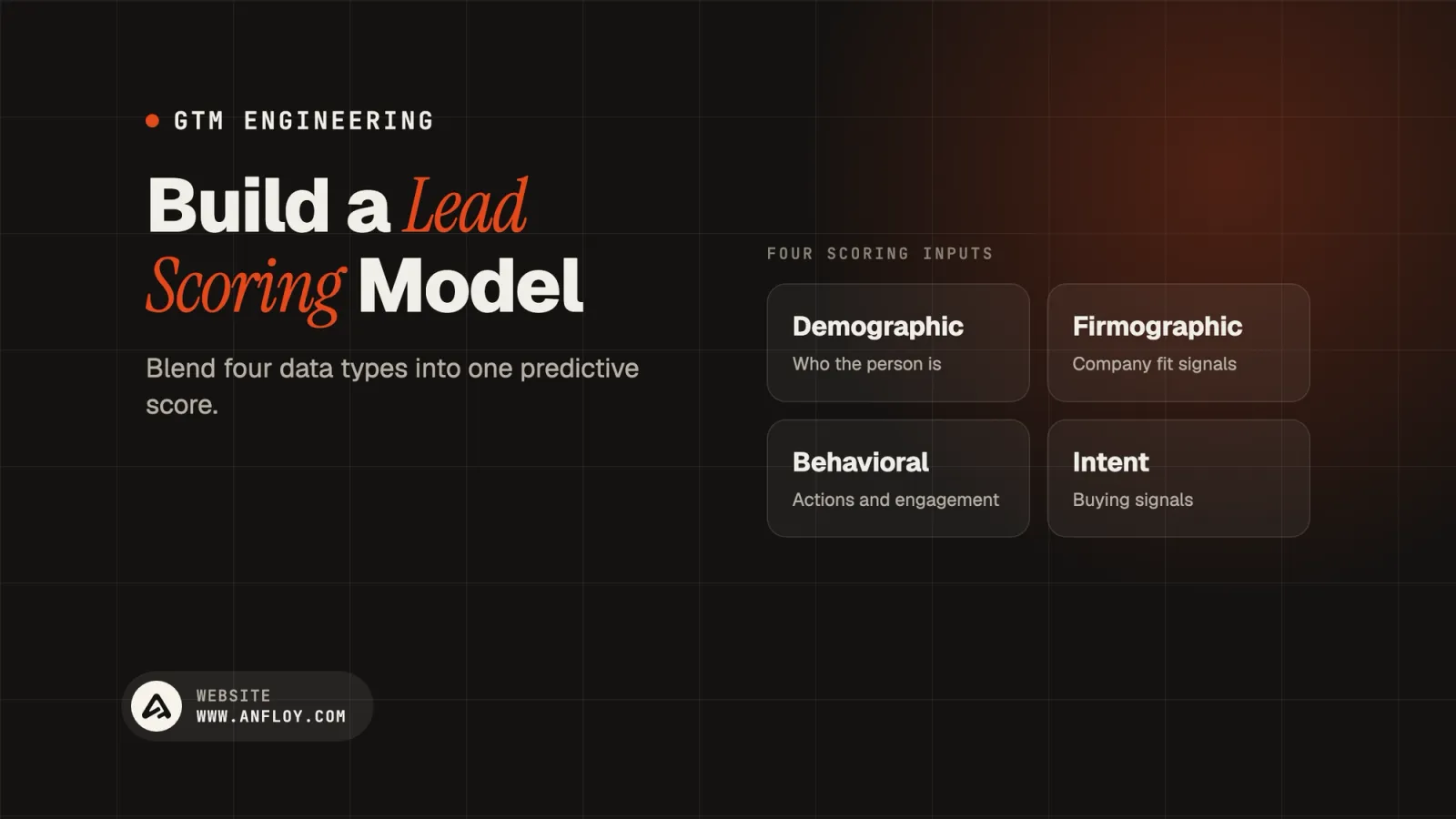
A strong B2B lead scoring model typically considers four dimensions.
Fit
Does the lead look like our ideal customer?
Includes:
- Industry
- Company size
- Revenue
- Geography
- Technology
- Business model
Role
Is this person relevant to the buying process?
Includes:
- Job title
- Seniority
- Department
- Decision-making authority
Behavior
What has the prospect done?
Includes:
- Website activity
- Content engagement
- Product activity
- Email engagement
Intent
Does the available evidence suggest active buying interest?
Includes:
- Pricing research
- Demo requests
- Product comparisons
- Business events
- Relevant intent signals
A simple model therefore becomes:
Lead Quality = Fit + Role + Behavior + Intent
How to build a lead scoring model?
Step 1: Define the ideal customer profile
Start with your best customers.
Analyze:
- Industry
- Company size
- Revenue
- Geography
- Technology
- Business model
- Buyer roles
Do not create scoring criteria before understanding which characteristics correlate with successful customers.
Step 2: Analyze historical customers
Look at converted customers and compare them with leads that did not convert.
Ask:
- Which industries convert most often?
- Which company sizes have the highest win rates?
- Which job titles become opportunities?
- Which behaviors precede conversion?
- Which signals appear before sales engagement?
Historical conversion data should inform the model.
Step 3: Separate fit from engagement
Do not combine everything into one unexplained score.
Consider maintaining:
Fit Score
and
Engagement Score
For example:
Fit Score = 75
Engagement = 20
--------------------
Total = 95
This makes the score easier for sales teams to interpret.
Step 4: Assign weights
Give greater importance to signals that correlate strongly with revenue outcomes.
For example:
Company Fit 30%
Buyer Fit 20%
Engagement 20%
Intent 30%
The percentages are examples, not universal benchmarks.
Your historical data should determine the weighting.
Step 5: Add negative criteria
Identify characteristics that consistently correlate with poor outcomes.
Negative scoring helps prevent false positives.
Step 6: Define score thresholds
Create operational categories.
For example:
| Score | Category | Action |
|---|---|---|
| 0–30 | Low | Nurture |
| 31–60 | Medium | Marketing |
| 61–80 | High | Sales review |
| 81–100 | Very High | Immediate sales action |
The threshold should be calibrated against your historical conversion rates.
Step 7: Connect the score to routing
Scoring becomes much more valuable when it triggers an action.
For example:

Lead Score
    ↓
 ┌──┼────┐
 ▼  ▼    ▼
Low Med  High
 ↓   ↓    ↓
Nurture Monitor Sales
A high score can trigger:
- Sales assignment
- Sales notification
- Account research
- Personalized outreach
- CRM task
Lead scoring model example for B2B SaaS
Consider a B2B SaaS company selling project management software.
A simplified model might be:
| Criterion | Points |
|---|---|
| 100+ employees | +15 |
| Target industry | +15 |
| Manager+ role | +10 |
| Target geography | +10 |
| Product page visit | +5 |
| Pricing page visit | +10 |
| Demo request | +30 |
| Trial signup | +25 |
| Competitor | -20 |
| Outside market | -15 |
The score can then determine the next action.
0–30
Nurture

31–60
Marketing Qualified

61–80
Sales Review

81+
Sales Priority
The model should be tested against historical conversion data before becoming the basis for automated sales routing.
Lead Scoring Model for SaaS
SaaS businesses can use both pre-sale and product-usage signals.
A SaaS model might combine:
Account Fit
- Employee count
- Industry
- Revenue
- Technology
Buyer Fit
- Role
- Seniority
- Department
Marketing Engagement
- Website activity
- Content
Product Signals
- Trial activation
- Feature usage
- Number of users
- Usage frequency
Commercial Intent
- Pricing activity
- Demo
- Sales inquiry
This creates a more complete view of customer readiness.
Lead scoring model for enterprise
Enterprise scoring should usually emphasize account quality and buying context.
Useful factors include:
- Strategic account status
- Revenue
- Number of employees
- Geographic footprint
- Technology environment
- Existing relationships
- Buying committee
- Business initiative
- Intent
- Engagement
A single contact score may not be enough.
Enterprise organizations may benefit from account scoring + contact scoring + opportunity scoring.
Lead scoring model for startups
Startups often lack enough historical data to build predictive models.
A simple rules-based model is usually a better starting point.
Focus on:
- ICP fit
- Buyer role
- High-intent actions
- Product engagement
- Lead source
Avoid building an unnecessarily complex scoring system before sufficient conversion data exists.
What are the common lead scoring mistakes?
Scoring every activity equally
A pricing-page visit should not necessarily carry the same weight as a blog visit.
Using too many variables
More signals can make a model harder to understand and maintain.
Start with the strongest predictors.
Ignoring negative signals
A lead can be highly engaged and still be a poor customer fit.
Never recalibrating the model
Markets change.
Your ICP changes.
Products change.
Sales motions change.
Review scoring performance periodically.
Treating the score as a truth
A score is a decision-support mechanism.
It is not a guarantee that a lead will buy.
How AI changes lead scoring?
Traditional lead scoring is largely rule-driven.
AI-powered scoring introduces contextual interpretation.
Instead of asking:
Did the company visit the pricing page?
AI can ask:
Does the available evidence indicate that this company has a problem our product solves and is currently evaluating solutions?
This enables richer qualification.
However, AI should remain measurable.
A production AI scoring system should track:
- Accuracy
- False positives
- False negatives
- Human acceptance
- Conversion
- Pipeline
- Revenue
The best architecture is often hybrid:
Rules for certainty + AI for interpretation + humans for exceptions.
Lead scoring and lead routing
Lead scoring should connect directly to the routing system.
For example:
Lead
 ↓
Enrichment
 ↓
Lead Scoring
 ↓
Qualification
 ↓
Routing
 ↓
Sales Action
A high-scoring enterprise lead might go directly to a named account executive.
A medium-scoring SMB lead could enter a round-robin process.
A low-scoring lead could remain in marketing nurture.
This transforms scoring from a reporting metric into an operational decision system.
What are the top lead scoring KPIs?
Measure whether the scoring model actually improves revenue operations.
Important metrics include:
- Lead-to-MQL conversion
- MQL-to-SQL conversion
- SQL-to-opportunity conversion
- Opportunity-to-customer conversion
- Sales response time
- Pipeline generated
- Revenue generated
- False-positive rate
- False-negative rate
- Sales acceptance rate
The most important question is:
Do higher-scoring leads actually convert at a higher rate?
If not, the model needs recalibration.
Want to turn lead scoring into an automated revenue workflow?
A lead scoring model is only useful when it helps your team decide which leads to prioritize and what action to take next.
If you want to build a smarter lead scoring, qualification, and routing system for your business, book a call with Anfloy to discuss your requirements and explore how AI can automate your revenue workflow.
Conclusion
A lead scoring model provides a structured method for prioritizing prospects based on fit, behavior, intent, and other customer signals.
The strongest models are not necessarily the most complicated.
They are:
- Based on real customer data
- Easy to understand
- Connected to sales workflows
- Continuously measured
- Updated as the business changes
Start with a simple model.
Validate it against actual conversion data.
Then introduce predictive analytics, AI, data enrichment, and automation as your data maturity increases.
The ultimate goal is not to produce a perfect score.
It is to help the revenue team answer one practical question:
Which leads should we act on next, and why?
Frequently Asked Questions
What is a good lead scoring model?
A good model is based on historical customer data, uses meaningful criteria, distinguishes positive and negative signals, and connects scores to clear sales or marketing actions.
How do you create a lead scoring model?
Define your ICP, analyze historical conversions, identify predictive attributes and behaviors, assign weights, establish score thresholds, connect scores to workflows, and continuously measure performance.
What are the four types of lead scoring?
Common approaches include demographic scoring, firmographic scoring, behavioral scoring, and predictive or AI-powered scoring. Many modern B2B models combine several approaches.
What is an example of lead scoring?
A company might assign points for target industry, company size, buyer seniority, pricing-page activity, demo requests, and product engagement while subtracting points for poor-fit characteristics.
What is predictive lead scoring?
Predictive lead scoring uses historical data and statistical or machine-learning methods to estimate which leads are most likely to convert.
Should lead scoring be automated?
Yes, once the model has been tested and validated. Automated scoring can update records, trigger lead routing, and initiate appropriate workflows.
How often should a lead scoring model be updated?
Review it regularly and recalibrate it whenever the ICP, product, sales motion, market, or conversion patterns change. The frequency should depend on how quickly those variables change.
Let's build
what your
company needs.
Drop your email. We'll send The Custom Agent Blueprint on what we'd build first for a company like yours, before you ever take a meeting.