
GTM Automation Testing & QA: Validate Before Launch
A practical testing and QA framework for GTM automations: what to test before launch, how to validate against real data safely, and the regression testing discipline most workflows skip.
On this page
- Why GTM Automation Testing Is Genuinely Different From Software QA
- What to Actually Test Before Launch
- How to Validate Safely Against Real Data Without Touching Real Prospects?
- Regression Testing: The Discipline Most Teams Skip Entirely
- Building a QA Checklist Into Your Deployment Process
- Common Mistakes in GTM Automation Testing
- A Worked Example
- How I Approach Testing and QA for GTM Automations?
- Conclusion
I covered shadow mode and canary rollout briefly inside the GTM engineering playbook, as part of a broader rollout sequence for a workflow you've already decided to build.
This piece is about what happens before that, the testing and QA discipline that determines whether a workflow is actually ready to enter that rollout sequence at all, rather than something that looks finished in a demo and falls apart the first time it meets real, messy production data or a genuinely confused prospect.
GTM automation testing gets skipped more often than it should, for an understandable reason: a workflow that enriches a lead or sends a message doesn't fail the way a crashed application does, loudly and obviously.
It fails quietly, sending a slightly wrong message, routing a lead to the wrong rep, or scoring an account incorrectly, and quiet failures are exactly the kind that accumulate real cost before anyone notices the pattern.
This guide covers what to actually test, how to validate a workflow safely before it touches real prospects, and the regression testing discipline most GTM teams never build at all.
Why GTM Automation Testing Is Genuinely Different From Software QA
Traditional software QA tests against deterministic, known expected outputs, the function should return exactly this value given exactly this input.
A meaningful share of GTM automation testing is considerably messier, because the inputs are genuinely messy, real prospect data, varied and inconsistent CRM records, and because a growing share of GTM workflows involve AI-generated output, a personalized message, a qualification judgment, that doesn't have one single, deterministic correct answer to test against.
This means GTM automation testing needs two distinct testing disciplines running alongside each other: deterministic testing for the parts of a workflow that genuinely do have a single correct answer, did the enrichment field actually get populated, did the record route to the correct owner.
A more qualitative, sample-based evaluation discipline for the parts that don't, is this generated message actually good, is this qualification judgment reasonable given the input.
Treating both as the same kind of testing, or worse, only testing the deterministic parts and assuming the AI-generated parts are fine because they look plausible, is where most GTM automation testing falls short.
What to Actually Test Before Launch
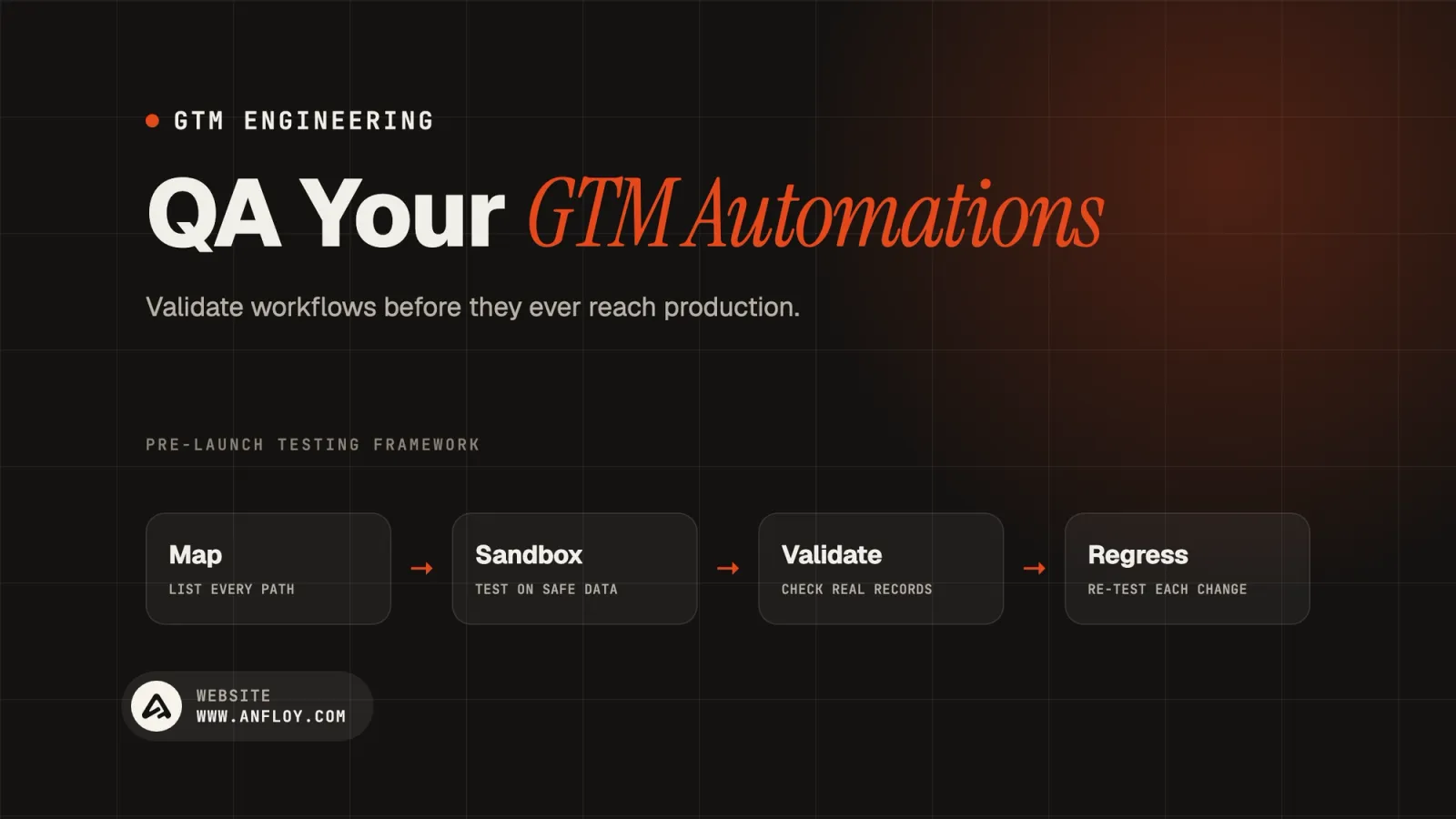
Happy path: does it work on the case it was obviously designed for
Start here, but don't stop here. Confirm the workflow produces the correct output on a clean, representative, well-formed input, the case the workflow was explicitly designed to handle.
This is necessary and almost never sufficient on its own, since production data is rarely as clean as whatever test case you built the workflow against initially.
Edge cases: missing data, malformed input, and boundary conditions
Test what happens when a field the workflow expects is actually empty, when a name has unusual characters or formatting, when a value sits right at a defined threshold boundary, scoring logic right at a tier cutoff, a date calculation right at a decay window's edge.
These edge cases are where most real-world workflow failures actually originate, not in the happy path, and deliberately constructing test inputs that probe these boundaries rather than hoping they never come up is what separates genuine testing from a quick, reassuring sanity check.
Failure and exception handling: does the workflow fail gracefully
Deliberately feed the workflow an input designed to make a step fail, an enrichment API call that returns an error, a malformed record that breaks a parsing step, and confirm the workflow handles that failure the way you actually intend, routing to a defined fallback, flagging for human review, logging the failure clearly, rather than crashing silently or, worse, producing a plausible-looking but actually incorrect output that proceeds downstream as if nothing went wrong.
Volume and concurrency: does it hold up at real scale, not just a small sample
A workflow validated against ten test records can behave very differently once it's processing your actual production volume, hitting rate limits, timing issues, or genuine concurrency bugs a small sample never surfaces, the same distinction covered in more depth in orchestrating AI agents in production.
Testing at a volume genuinely representative of production, not just enough to confirm the logic runs at all, is a distinct and necessary testing step, not an optional extra.
AI-generated output quality: evaluating the non-deterministic parts deliberately
For any step generating AI output, a personalized message, a qualification judgment, a summarized insight, build an explicit evaluation process rather than eyeballing a few examples and assuming it's fine.
This typically means defining specific quality criteria, is the message genuinely specific to the account rather than generic, does the qualification judgment align with what a human reviewer would independently conclude given the same input.
Evaluating a representative sample against those criteria deliberately, the same evaluation discipline covered in more depth in AI agent architecture.
Want a read on whether your current workflows have actually been tested against real edge cases, or just the happy path? Get a free AI infrastructure audit and I'll help you find the gaps.
How to Validate Safely Against Real Data Without Touching Real Prospects?
Run the workflow against real, current production data, but intercept the final action. The most reliable test uses genuinely real, messy data, not a cleaned-up synthetic test set that doesn't reflect your actual production conditions, but with the final, consequential step, sending a message, writing to the CRM, intercepted and logged rather than actually executed.
This is effectively the shadow mode stage covered in more depth in the GTM engineering playbook, and it's the single most valuable testing technique available for catching a workflow's real behavior on real data without any risk of a bad output actually reaching a prospect or corrupting a live record.
Use a staging or sandbox version of destination systems wherever one's available. Many CRMs and enrichment tools offer a sandbox or test environment specifically for this purpose.
Running a workflow against a genuine sandbox, rather than production data with the final step merely intercepted in code, provides an even safer validation layer, catching integration-level issues, a malformed API call, an unexpected field type, that a purely code-level interception might miss.
Build a representative, curated test set covering your known edge cases, and keep it versioned.
Beyond ad hoc testing against live data, maintain an explicit, curated set of test records specifically representing the edge cases you've identified, missing fields, boundary values, previously-discovered failure patterns, and keep this test set in version control alongside the workflow itself.
Sso every future change to the workflow gets run against the same known set of tricky cases rather than relying on whoever happens to remember to check manually.
Have a second person review AI-generated output before trusting your own assessment.
The person who built a workflow is often the worst-positioned person to objectively evaluate its output, since they know what it's supposed to produce and tend to read generated output more charitably than someone encountering it fresh.
A second reviewer, ideally someone who'd actually be on the receiving end of the output in a real context, a rep, a prospect-facing colleague, provides a genuinely more honest quality check.
Regression Testing: The Discipline Most Teams Skip Entirely
Define what should never break, and test for it on every change. A regression test confirms that a change to a workflow didn't break something that was previously working correctly.
For GTM automation specifically, this means maintaining the curated edge-case test set mentioned above and running it against the workflow every time a meaningful change is made, a prompt adjustment, a new data source added, a scoring threshold changed, rather than only testing the specific thing that changed and assuming everything else still works as before.
Treat a prompt change with the same testing rigor as a code change. A common and genuinely risky assumption: that adjusting an AI prompt is a low-risk, cosmetic change not requiring the same testing discipline as a logic change.
A prompt adjustment can shift a model's output distribution in ways that aren't obvious from reading the prompt diff alone, which is exactly why it deserves the same regression testing, run against the same curated edge cases, as any other meaningful change to the workflow.
Track output quality over time, not just at the moment of initial launch. A workflow that passed every test at launch can still degrade later, an upstream data source changes its format, a model update subtly shifts output behavior, a downstream API's rate limits tighten.
Periodic re-evaluation against the same test set, run on an ongoing schedule rather than only at launch, is what catches this kind of slow, silent degradation before it compounds into a visible problem.
Version your test set alongside your workflow logic, in the same repository. Keeping test cases and workflow logic versioned together means a specific version of a workflow is always paired with the specific test set it was validated against, making it possible to trace exactly what was tested, and what wasn't, for any given point in the workflow's history.
Building a QA Checklist Into Your Deployment Process
Require explicit sign-off against a defined checklist before a workflow moves from testing into live, canary rollout.
A simple, consistently-applied checklist, happy path confirmed, edge cases tested, failure handling verified, AI output quality reviewed by a second person, volume tested at a realistic scale, prevents a workflow from skipping a testing step simply because launch felt urgent in the moment.
This doesn't need to be elaborate, it needs to be consistently applied rather than treated as optional under time pressure.
Define a clear rollback plan before launch, not after something goes wrong.
Know in advance exactly how to pause or revert a workflow if testing missed something that only surfaces once it's live, and confirm that rollback mechanism actually works before you need it under real pressure, not as an untested assumption you're relying on for the first time during an actual incident.
Make testing evidence, not just a verbal confirmation, part of the deployment record. A log of what was actually tested, which edge cases, what volume, who reviewed the AI output.
Is worth keeping alongside the workflow itself, the same documentation discipline covered in more depth in AI agent audit trails, applied here to the pre-launch testing process specifically rather than ongoing production monitoring.
Common Mistakes in GTM Automation Testing
Testing only the happy path and assuming edge cases will surface naturally in production.
This is the single most common gap, and it's directly responsible for the quiet, slow-accumulating failures that are specifically hard to notice, since each individual edge-case failure looks like an isolated, unexplained anomaly rather than part of a pattern a dedicated edge-case test would have caught upfront.
Eyeballing a handful of AI-generated outputs and declaring quality acceptable without a defined evaluation process.
A quick, informal glance at a few examples is a weak substitute for genuine, criteria-based evaluation against a representative sample, and it's particularly prone to the charitable-reading bias a workflow's own builder brings to assessing their own creation.
Treating a prompt tweak as too minor to warrant regression testing. A small, seemingly cosmetic prompt change can shift output behavior in ways that only become visible once run against the full edge-case test set, and skipping that test specifically because the change felt minor is a genuinely common, genuinely risky shortcut.
No versioned, reusable test set, so every testing pass starts from scratch.
Without a maintained, curated set of known edge cases, every round of testing relies on whoever's doing it remembering to manually think up the same tricky scenarios again, which is unreliable and inconsistent compared to running an explicit, version-controlled test set every time.
Skipping volume testing and discovering a concurrency or rate-limit issue only in production.
A workflow that works fine against a handful of test records can hit a genuine capacity problem only once it's processing real production volume, and that gap between small-sample testing and real-world scale is exactly where async architecture issues tend to first become visible, often at the worst possible moment, during a genuine production launch rather than a controlled test.
A Worked Example
A GTM engineer builds a workflow that scores inbound leads and generates a personalized first-touch email based on the lead's enriched account data. Initial testing against five clean, well-formed example leads looks genuinely good, the scores seem reasonable, the generated emails read as specific and relevant.
Before launch, they build a more deliberate edge-case test set: a lead with a missing company name, a lead with an unusually formatted job title, a lead whose enrichment data returned nothing useful from any source, and a lead sitting right at the defined scoring threshold between two tiers.
Running the workflow against this edge-case set surfaces two real issues the happy-path testing missed entirely: the lead with no usable enrichment data produces a generated email that's vague to the point of being generic, since the personalization step had nothing specific to actually reference, and the boundary-case lead's score flickers between two tiers depending on rounding behavior in the scoring formula that hadn't been tested at that specific boundary value.
Both issues get fixed before launch, adding an explicit fallback for thin enrichment data that flags the lead for manual review rather than generating a weak, generic message, and correcting the rounding logic at the tier boundary.
The team keeps this edge-case test set in version control alongside the workflow, and three months later, when a prompt adjustment is made to improve message tone, running the same test set catches a regression.
The new prompt phrasing had inadvertently made the thin-enrichment fallback case less reliable than before, a problem that would likely have gone unnoticed without the regression test, since the specific edge case it caught wasn't the part of the workflow anyone was actually thinking about when making the tone adjustment.
How I Approach Testing and QA for GTM Automations?
I build explicit, versioned edge-case test sets alongside every GTM workflow I design, run as regression tests against any meaningful future change, not just at initial launch.
This connects directly to my broader work on AI GTM pilots and deploying AI agents into production, where genuine, deliberate testing before launch is what makes the difference between a pilot that produces real, trustworthy evidence and one that just confirms a workflow works on the easy cases it was obviously designed for.
Every workflow I build ships with a documented testing record, what was tested, what the known edge cases are, who reviewed the AI-generated output, so the evidence behind a launch decision is something you can actually verify rather than take on faith.
Not sure whether your current workflows have actually been tested against real edge cases before going live? See how my process works before your next launch.
Conclusion
A GTM automation that looks finished in a demo and a GTM automation that's genuinely ready for production are different things, and the gap between them is almost entirely a testing discipline: happy path confirmed, edge cases deliberately probed, failure handling verified, AI-generated output evaluated against real criteria rather than eyeballed, volume tested at realistic scale, and a versioned regression test set that catches a future change breaking something that used to work.
The teams whose GTM automations hold up over time aren't the ones who built the most sophisticated workflow logic, they're the ones who treated testing as a genuine discipline rather than a quick sanity check before launch.
Ready to build a testing process that actually catches problems before they reach real prospects? Book a call, no decks, no demos, just a working session on your current workflows.
Frequently Asked Questions
How is testing a GTM automation different from testing traditional software?
GTM automation testing needs to handle two distinct categories: deterministic logic, like whether a record routed correctly, which can be tested the way traditional software is, and non-deterministic AI-generated output, like a personalized message, which requires a criteria-based quality evaluation against a representative sample rather than a single, fixed expected answer.
What's the minimum testing a GTM workflow should go through before launch?
At minimum, confirm the happy path works, test against a curated set of known edge cases, missing data, boundary values, verify the workflow fails gracefully rather than silently when a step encounters an error, and for any AI-generated output, have a second person evaluate quality against defined criteria rather than relying solely on the builder's own assessment.
Why does a small prompt change need the same testing as a bigger logic change?
A prompt adjustment can shift a model's output behavior in ways that aren't obvious from reading the prompt text alone, sometimes affecting edge cases that have nothing to do with what the change was intended to address. Running the same regression test set against any prompt change, not just larger logic changes, is what catches this kind of unintended side effect before it reaches production.
How do I test a workflow against real data without actually risking real prospects?
Run the workflow against genuine, current production data but intercept the final, consequential action, sending a message, writing to a live CRM record, logging what would have happened rather than executing it. This is effectively a shadow mode test, and it's the most reliable way to see a workflow's real behavior on real, messy data without any risk of a bad output actually reaching a prospect.
How often should a workflow be re-tested after its initial launch?
Whenever a meaningful change is made, a prompt adjustment, a new data source, a threshold change, and ideally on a periodic schedule even without an explicit change, since upstream data sources and underlying models can shift in ways that silently degrade a workflow's output quality over time without any code change on your end triggering the degradation.
Let's build
what your
company needs.
Drop your email. We'll send The Custom Agent Blueprint on what we'd build first for a company like yours, before you ever take a meeting.