
GTM Strategy for Product-Led Growth: Outbound from Free Users
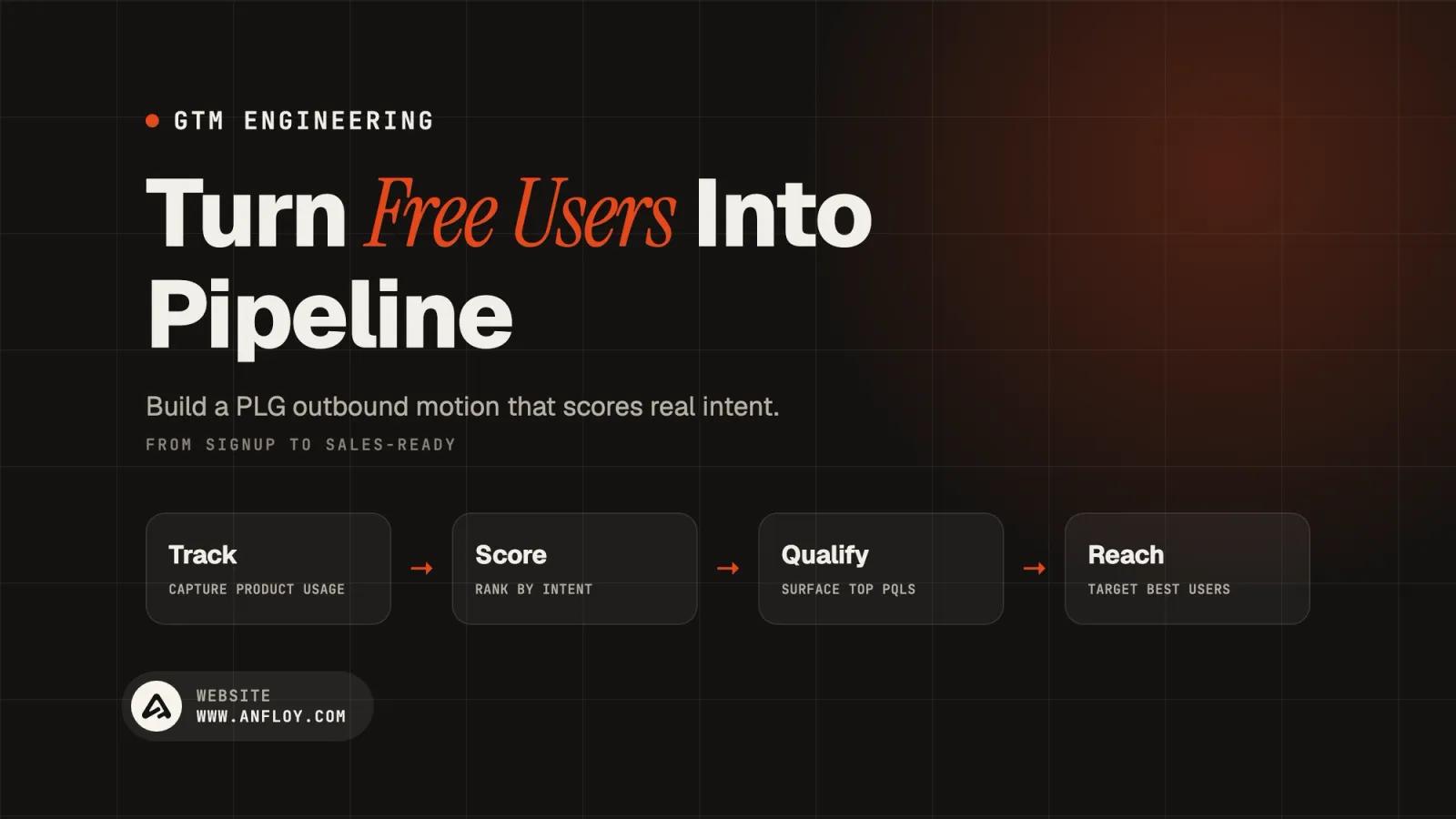
Learn how to build a PLG outbound motion that scores product usage into real product-qualified leads and turns your best free users into pipeline without spamming the rest.
On this page
- What is PLG outbound?
- Why the self-serve ceiling exists?
- The entity behind PLG outbound: the product-qualified lead
- Building a PQL scoring model
- How the outbound layer should actually work?
- Why PLG outbound messaging has to be different?
- Anti-patterns that quietly undermine PLG outbound
- A worked example: From free user to booked meeting
- How Anfloy builds PLG outbound systems?
- Conclusion
Every product-led company eventually stares at the same dashboard: a healthy signup number, a flat revenue line, and a handful of free-tier accounts with a dozen active users who will never touch the upgrade button on their own.
Product-led growth is efficient at the bottom of the market. A single user can find the product, get value, and pay with a card, and no rep ever needs to get involved. But that efficiency breaks the moment a deal needs more than one person to say yes.
A buying committee doesn't self-serve through procurement, security review, and executive sign-off. It stalls in your free tier, quietly, while the usage data sitting in your product tells you exactly which accounts are ready and nobody ever calls them.
This is where PLG outbound comes in: a motion built on top of self-serve, not a replacement for it, that identifies the free and trial users worth a human touch and reaches them with a message grounded in what they actually did in the product, not a cold list.
What is PLG outbound?
PLG outbound is the practice of turning a company's best free and trial users into a targeted, sales-assisted pipeline instead of waiting indefinitely for them to convert through self-serve alone.
It works by identifying a genuine product-qualified lead, scoring it, and sequencing only the accounts that clear a defined threshold, rather than treating every signup as a prospect.
The distinction that matters is what makes it different from ordinary cold outbound: the intent data comes from your own product. A cold list tells you a company might be a fit.
Product usage tells you a specific account is already getting value, which is a fundamentally stronger starting point than any purchased list will ever provide.
Why the self-serve ceiling exists?
Self-serve motions scale beautifully at the low end of the market and then hit a structural wall as deal size grows.
The pattern shows up consistently across product-led companies:
- Buying committees don't self-serve. Once a purchase decision involves procurement, legal, security review, or an executive sponsor, a self-serve checkout flow has nowhere to route that complexity.
- Budget owners rarely sign up personally. The person exploring your product in a free trial is often an individual contributor or a mid-level user, not the person with authority to approve a five- or six-figure contract.
- Team expansion inside a free tier is a signal, not a conversion event. An account with ten active seats on a free plan has proven product value at scale, but nothing in the self-serve flow prompts anyone to act on that.
The tell that a company has hit this ceiling is specific: accounts with real usage, multiple active users, and clear value realization that simply never talk to a human or upgrade past a seat cap.
That's not a pricing problem. It's a coverage gap, and PLG outbound is the layer that closes it.
The entity behind PLG outbound: the product-qualified lead
The single most common reason a PLG outbound motion fails is a weak definition of who actually qualifies. Most teams default to "someone who used the product," which is close to meaningless.
A trial user who ran one report once isn't qualified. A highly engaged solo user who will never carry a budget isn't either.
A real product-qualified lead is the product of three factors, not the sum of them. If any one factor is close to zero, the account isn't ready, no matter how strong the other two look.
Usage depth
The activation events that actually correlate with paying: inviting teammates, connecting a data source, completing the core workflow repeatedly, hitting a usage or seat limit. Logins and page views don't count; they're activity, not value realization.
Account fit
Whether the company behind the user matches the profile of an account that can and should buy: right industry, right size, right role for the person using the product.
This is the same ICP scoring discipline applied to a warmer, better-informed dataset.
Buying signal
The live, time-bound event that says the moment is now: a usage spike, a second or third teammate joining from the same domain, the account hitting a plan ceiling, a relevant new hire, fresh funding.
This is signal-based selling applied to product telemetry instead of external company news.
Multiplying these factors, rather than adding them, is the important design choice. A perfect-fit enterprise account with deep usage but no fresh signal is a nurture candidate, not a call today.
A sharp usage spike from an account that will never have budget is noise. The accounts worth a rep's time are where all three land together.
Building a PQL scoring model
Once a PQL is understood as three multiplied factors, the next step is turning that definition into something operational: a scoring model that produces the same tag for the same account regardless of who's looking at it.
| Factor | Signal | Why it matters |
|---|---|---|
| Usage depth | Core workflow completed repeatedly | Proves real activation, not a one-time trial |
| Usage depth | Hit a free-plan usage or seat limit | The strongest natural upgrade cue |
| Account fit | Company matches ICP size and industry | Filters out accounts that will never carry budget |
| Account fit | User holds a buying or influencing role | An individual contributor rarely closes alone |
| Buying signal | Multiple new signups from the same domain in a short window | Team adoption spreading is a live expansion signal |
| Buying signal | Fresh funding, a relevant new hire, or a usage spike | A time-bound trigger that says act now |
The exact weights matter less than the discipline of using a model consistently and recalibrating it against which scored accounts actually became opportunities, the same lead scoring practice applied anywhere else in the funnel.
A workable structure uses two thresholds rather than one. A high bar, with a signal present from each of the three factors, defines a PQL that a rep sequences now.
A lower band defines an account that isn't ready for a human yet but should move into lightweight, automated nurture rather than being ignored.
Everything below both stays in the self-serve funnel untouched.
How the outbound layer should actually work?
Not every PQL should get sequenced, and the reasoning is about timing as much as capacity. If a team can realistically work a fixed number of conversations a week, the system should surface the top accounts by score and recency, not flood reps with every account that technically clears the bar.
Timing is the part that separates PLG outbound from a disguised list blast. The right moment to reach out sits inside the window where a user just felt something in the product: they hit a seat limit yesterday, a third teammate joined this morning, they ran the core workflow several times in two days and then stalled.
A message sent weeks after that window closes converts like cold outbound, because by then, functionally, it is.
Operationally, this requires three pieces working together: a source of product usage events, a scoring process that combines those events with fit data to produce a PQL score, and a trigger that enrolls a qualified account into a sequence with an owner assigned the moment it crosses the threshold inside a live signal window.
This is the same discipline behind how to build a signal-based outbound engine, applied to a company's own first-party product data instead of external intent sources, which is a structural advantage no competitor can see or copy.
Want to see what PQL scoring would look like against your own product data? Get a free AI infrastructure audit and we'll map it.
Why PLG outbound messaging has to be different?
The message is where a PLG outbound motion either earns trust or burns it, because the entire premise depends on warm context. Cold outbound has to earn attention from a stranger.
PLG outbound starts from a relationship that already exists: the person is already in the product, so the job of the message is to be useful about what they're doing, not to pitch from a standing start.
The strongest messages reference usage at the account level, specifically enough to feel attentive without crossing into surveillance. Noting that a team has grown to several active users and offering to help set up shared permissions reads as service.
Referencing an individual user's specific in-app behavior reads as invasive. The distinction is the difference between an attentive account manager and someone watching too closely, and it determines whether the message converts or gets the account to churn out entirely.
Channel and tone matter just as much as content. A person who chose self-serve specifically to avoid a sales process doesn't want an aggressive, multi-touch cadence forcing a call.
They want a low-friction, genuinely helpful nudge with a small, clear next step, an offer to help, not a demo pitch.
This is the same principle behind personalizing cold outreach with AI agents, applied to a buyer who has already told you, by choosing self-serve, exactly how they want to be approached.
Anti-patterns that quietly undermine PLG outbound
PLG outbound carries a risk cold outbound doesn't: it can damage a relationship that was already working in your favor.
A free user on a healthy path toward upgrading can be pushed away by outreach done carelessly.
Sequencing every signup.
The moment a team reaches everyone who creates an account, it's running cold outbound with extra steps, burning rep time on unqualified conversations and annoying users who wanted to explore on their own terms.
If more than a small fraction of new signups is entering a human sequence, the threshold is set too low.
Referencing usage in a way that feels invasive.
Account-level awareness reads as attentive. Individual-level surveillance reads as creepy. When in doubt, keep the reference at the account level only.
Using a sales-heavy tone with a self-serve buyer.
This buyer chose PLG in part to avoid the traditional sales dance. A pushy, urgency-driven cadence contradicts the experience the product already promised them, and it's usually the fastest way to lose the trust that made them open to hearing from you in the first place.
Ignoring the accounts that don't clear the bar.
The lower-scoring band isn't dead pipeline, it's future pipeline. Those accounts deserve automated, product-led nurture that keeps them maturing toward the point where a human touch is warranted.
A worked example: From free user to booked meeting
A mid-market company has three employees sign up for a free plan over a couple of weeks, all from the same domain.
No single signup looks remarkable, but the system is watching the account, not just the individual user.
The score builds from real signals: the company matches the target ICP on size and industry, one signup holds a director-level title, the account has completed the core workflow well beyond a single trial run, and a third teammate joined from the same domain within the signal window.
Together, these cross the high threshold with a signal present from all three factors, and the account surfaces at the top of the queue with an owner assigned automatically.
The sequence that fires doesn't open with a pitch. It notes that a few people from the company are now using the product together and offers to help set the workspace up properly, mentioning that teams this size typically want shared permissions and consolidated billing.
It references the account-level reality, arrives while the coordination pain is still fresh, and offers a small, useful next step rather than a demo request.
A reply that turns into a fifteen-minute conversation about team setup, and from there into a conversation about a paid plan, isn't the product of an aggressive cadence.
It's the product of good timing and a message anchored in something real. That's the entire PQL-to-pipeline motion working as designed.
How Anfloy builds PLG outbound systems?
Anfloy builds the full PQL-to-pipeline motion end to end: the scoring model wired directly to product telemetry, the trigger logic that respects signal windows instead of a fixed cadence, and the message design calibrated to a self-serve buyer rather than a cold-outbound one.
This sits alongside the broader AI prospecting systems and outbound engines we build for GTM teams, applied specifically to the first-party signal advantage a PLG company already has and usually isn't using.
Every system is deployed on infrastructure you own outright, connected directly to your product analytics and your CRM, with no dependency on a third-party platform holding the scoring logic hostage to its own roadmap.
Not sure whether your product data is ready to power this? See how our process works before scoping a build.
Conclusion
PLG outbound isn't cold outbound with a different lead source. It's a motion built entirely on the advantage a product-led company already has and most aren't using: first-party evidence of exactly which accounts are getting real value right now.
The teams that get this right don't sequence every signup. They define a precise product-qualified lead, score it consistently, and reach only the accounts where usage, fit, and timing all line up at once.
Ready to turn your free-tier data into a working pipeline motion? Book a call, no decks, no demos, just a working session on what to build first.
Frequently Asked Questions
How is a product-qualified lead different from a marketing-qualified lead?
A marketing-qualified lead is typically defined by engagement with content or campaigns, which correlates weakly with actual buying intent. A product-qualified lead is defined by real usage combined with account fit and a live signal, meaning the account has already experienced value in the product before any outreach happens, which is a much stronger starting point.
Should every free signup get an outbound touch?
No. Sequencing every signup functions as cold outbound with extra steps and tends to annoy users who chose self-serve specifically to avoid that experience. Only accounts that clear a defined, multi-factor threshold inside a live signal window should reach a human sequence; everything else belongs in automated nurture until it matures.
Why do product-led companies eventually need outbound at all?
Because self-serve motions have a structural ceiling. They handle small, single-decision-maker purchases efficiently but stall on deals that require a buying committee, procurement, or executive sign-off, none of which a checkout flow can resolve on its own. Outbound to product-qualified accounts is the layer that converts the deals the product alone can't close.
What's the most common mistake in PLG outbound programs?
A vague PQL definition, usually treating any product usage as qualification. That produces inconsistent sequencing and pushes teams toward reaching the entire signup base indiscriminately. A precise, multi-factor definition, usage depth, fit, and a live signal together, is what keeps the motion targeted and effective.
Let's build
what your
company needs.
Drop your email. We'll send The Custom Agent Blueprint on what we'd build first for a company like yours, before you ever take a meeting.