
GTM vs RevOps for SMEs: Differences, Costs & What You Need
Compare GTM vs RevOps for SMEs. Learn the differences between go-to-market strategy, Revenue Operations, GTM Engineering, responsibilities, costs, and when an SME needs each function.
On this page
- What is GTM?
- What is RevOps?
- GTM vs RevOps: The simple difference
- GTM vs RevOps for SMEs
- What does GTM do for an SME?
- What does RevOps do for an SME?
- GTM vs RevOps responsibilities
- GTM strategy vs RevOps strategy
- Where GTM engineering fits?
- GTM vs RevOps vs GTM engineering
- When does an SME need GTM?
- When does an SME need RevOps?
- When does an SME need GTM engineering?
- Do SMEs need a full RevOps team?
- GTM vs RevOps cost for SMEs
- How to decide: GTM or RevOps?
- A practical SME growth model
- How Anfloy helps SMEs?
- GTM vs RevOps: Common mistakes SMEs make
- Conclusion
For small and medium-sized businesses, GTM vs RevOps can look like a distinction without a difference.
Both functions touch sales, marketing, customers, data, technology, and revenue.
But they solve different problems.
Go-to-Market (GTM) defines how a company reaches its target market, creates demand, acquires customers, and generates revenue.
Revenue Operations (RevOps) creates the operational system that helps sales, marketing, and customer-facing teams work together efficiently.
For an SME, the distinction matters because hiring the wrong function too early can create unnecessary complexity.
A company with unclear positioning does not need a complicated RevOps stack.
A company with strong demand but broken lead management may need RevOps more than another GTM strategy project.
A company with multiple tools, repetitive workflows, AI initiatives, and data problems may eventually need GTM Engineering to build the systems underneath both.
The practical relationship is:
GTM decides where and how to compete.
RevOps makes the revenue process operate consistently.
GTM Engineering builds the technical systems that automate and connect that process.
What is GTM?
Go-to-market describes the strategy and execution used to bring a product or service to a defined market.
GTM can include:
- Ideal Customer Profile
- Market segmentation
- Positioning
- Messaging
- Pricing
- Distribution
- Sales strategy
- Marketing strategy
- Customer acquisition
- Partnerships
- Customer expansion
A GTM strategy answers questions such as:
Who should we sell to?
What problem do we solve?
Why should customers choose us?
How do we reach them?
Which sales and marketing channels should we use?
How do we convert demand into revenue?
For an SME, GTM is often closely connected to the founder, sales leader, or marketing leader.
What is RevOps?
Revenue Operations is the operational function that aligns revenue-generating teams, processes, data, and systems.
RevOps commonly connects:
- Marketing
- Sales
- Customer Success
- CRM
- Data
- Reporting
- Forecasting
- Process management
A RevOps function answers questions such as:
Are leads being routed correctly?
Does the CRM contain reliable data?
Can marketing and sales see the same customer information?
How quickly are leads receiving a response?
Where are opportunities getting stuck?
Can leadership accurately forecast revenue?
RevOps is therefore less about deciding which market to pursue and more about making the revenue process work reliably.
GTM vs RevOps: The simple difference
The simplest distinction is:
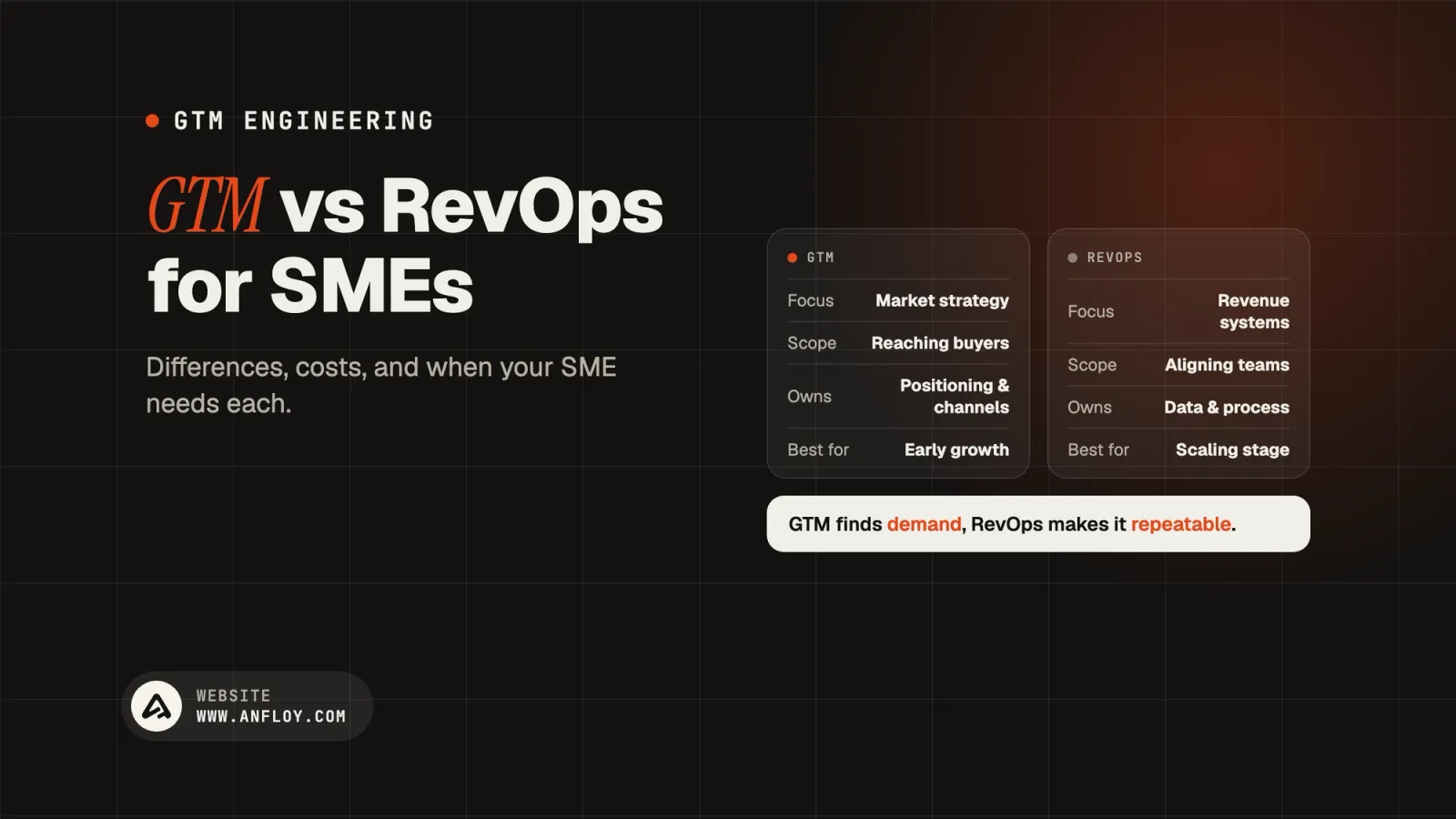
| GTM | RevOps |
|---|---|
| Defines the route to market | Operationalizes the revenue process |
| Focuses on customers and markets | Focuses on processes and systems |
| Defines ICP | Maintains data and segmentation |
| Defines positioning | Supports execution |
| Determines channels | Measures channel performance |
| Designs sales motion | Optimizes sales operations |
| Creates GTM strategy | Creates operational consistency |
| Focuses on growth | Focuses on revenue efficiency |
However, the functions overlap.
A GTM strategy may determine that enterprise accounts require dedicated account executives.
RevOps then needs to operationalize:
Enterprise Account → Qualification → Routing → AE → Pipeline → Forecast
This is where the two functions interact.
GTM vs RevOps for SMEs
The distinction becomes particularly important for SMEs because resources are limited.
An SME usually cannot afford to build every specialized function simultaneously.
The company needs to determine which problem is limiting growth.
Consider two businesses.
SME A
The company has:
- Unclear ICP
- Weak positioning
- Inconsistent messaging
- No predictable acquisition channel
This is primarily a GTM problem.
SME B
The company has:
- Strong demand
- Hundreds of inbound leads
- Multiple sales representatives
- Poor CRM data
- Slow lead response
- Inconsistent reporting
This is primarily a RevOps problem.
The solution depends on the bottleneck.
What does GTM do for an SME?
GTM provides the commercial direction.
An SME GTM function may define:
Target market
Which companies or customers should the business prioritize?
ICP
Which customer characteristics correlate with successful customers?
Positioning
How should the company be perceived relative to alternatives?
Messaging
What problems and outcomes should the company communicate?
Acquisition channels
Where should the company find customers?
Examples include:
- SEO
- Paid acquisition
- Outbound
- Partnerships
- Events
- Communities
- Product-led acquisition
Sales motion
Should the company use:
- Self-service
- Product-led growth
- Sales-assisted
- Enterprise sales
- Partner-led sales?
These decisions form the GTM strategy.
What does RevOps do for an SME?
RevOps turns the revenue process into an operating system.
Typical responsibilities include:
- CRM administration
- Lead management
- Lead routing
- Sales process
- Pipeline management
- Reporting
- Forecasting
- Data quality
- Territory management
- Sales operations
- Marketing operations
- Customer lifecycle management
For example, the GTM strategy might say:
"We target mid-market SaaS companies."
RevOps translates that strategy into operational processes:
Lead
 ↓
Enrichment
 ↓
ICP Qualification
 ↓
Mid-Market Classification
 ↓
Lead Routing
 ↓
Sales Owner
 ↓
Pipeline
 ↓
Forecast
GTM vs RevOps responsibilities
A practical SME structure looks like this:
| Activity | GTM | RevOps |
|---|---|---|
| ICP definition | ✓ | Support |
| Market segmentation | ✓ | Support |
| Positioning | ✓ | — |
| Messaging | ✓ | — |
| Channel strategy | ✓ | Support |
| Sales process | ✓ | ✓ |
| CRM | — | ✓ |
| Lead routing | Define rules | Build/manage |
| Lead scoring | Define criteria | Implement |
| Forecasting | — | ✓ |
| Pipeline reporting | — | ✓ |
| Data governance | — | ✓ |
| GTM strategy | ✓ | Support |
| Revenue reporting | Support | ✓ |
| Automation | Define requirements | Implement |
| GTM infrastructure | Define needs | Build/manage |
The exact ownership depends on company structure.
GTM strategy vs RevOps strategy
These are not the same thing.
A GTM strategy defines how the company will acquire and serve customers.
A RevOps strategy defines how the organization will operationalize and measure that GTM motion.
For example:
GTM strategy
Focus on US-based B2B SaaS companies with 200–2,000 employees.
RevOps strategy
Create an enterprise segment, enrich company size and industry, assign accounts by territory, route qualified leads to the correct representatives, and report conversion by segment.
The first defines the commercial direction.
The second creates operational execution.
Where GTM engineering fits?
There is another function SMEs increasingly need to understand:
GTM Engineering.
GTM Engineering sits between GTM strategy, RevOps, data, AI, and technical implementation.
It can build:
- AI agents
- Lead routing
- Data enrichment
- Signal-based selling
- CRM automation
- Account research
- GTM workflows
- API integrations
- Revenue intelligence
The relationship can be represented as:
GTM Strategy
      ↓
Revenue Process
      ↓
RevOps
      ↓
GTM Engineering
      ↓
Systems + Data + AI
      ↓
Execution
This does not mean every SME needs all three as separate departments.
One person may perform several of these functions.
GTM vs RevOps vs GTM engineering
| Function | Primary Question |
|---|---|
| GTM | How should we win customers? |
| RevOps | How should the revenue process operate? |
| GTM Engineering | How can technology automate and improve that process? |
This distinction becomes increasingly important as an SME grows.
At an early stage, a founder may own GTM.
Later, a RevOps specialist may manage operational complexity.
As the technology stack expands, GTM Engineering can provide the technical layer.
When does an SME need GTM?
An SME should prioritize GTM work when the primary problem is market execution.
Typical signs include:
- Poor product-market fit
- Unclear target market
- Weak positioning
- Inconsistent messaging
- Unpredictable customer acquisition
- Too many acquisition channels
- Poor sales-market alignment
If the company cannot clearly explain who it serves, what problem it solves, and why customers should buy, RevOps will not solve the underlying issue.
When does an SME need RevOps?
RevOps becomes valuable when the company has enough revenue complexity to require operational coordination.
Common signals include:
- Multiple sales representatives
- Multiple acquisition channels
- Growing CRM complexity
- Leads falling through the cracks
- Poor pipeline visibility
- Inconsistent sales processes
- Duplicate customer records
- Forecasting problems
- Marketing-sales misalignment
At this point, operational inefficiency can become a meaningful growth constraint.
When does an SME need GTM engineering?
GTM Engineering becomes useful when the company has technical GTM complexity.
Signs include:
- Too many manual workflows
- Multiple GTM tools
- Complex CRM automation
- AI initiatives
- Data-enrichment requirements
- Signal-based selling
- Custom lead routing
- API integrations
- Large-scale account research
- Repetitive sales operations
For example:
CRM
 +
Enrichment
 +
Intent Data
 +
AI
 +
Sales Engagement
 +
Slack
 +
Analytics
If these systems need to work together, technical GTM expertise becomes increasingly valuable.
Do SMEs need a full RevOps team?
Usually, no.
An SME may begin with one person responsible for revenue operations.
Depending on the company's stage, this could be:
- RevOps specialist
- Sales Operations manager
- Operations generalist
- Revenue systems specialist
The function can expand as revenue complexity increases.
The important principle is:
Build operational capability in proportion to operational complexity.
Can One Person Handle GTM and RevOps?
Yes.
Early-stage SMEs often combine responsibilities.
A founder or commercial leader may handle:
- GTM strategy
- Sales
- Marketing
- Partnerships
An operations-oriented employee may handle:
- CRM
- Reporting
- Lead routing
- Automation
As the company grows, separating the responsibilities can improve specialization.
The separation should be driven by workload and complexity rather than organizational fashion.
GTM vs RevOps cost for SMEs
The cost difference depends heavily on whether the company hires employees, contractors, consultants, or agencies.
GTM consulting
A GTM consultant can help with:
- Market positioning
- ICP
- GTM strategy
- Channel strategy
- Sales motion
- Launch planning
RevOps consulting
A RevOps consultant can help with:
- CRM
- Sales process
- Reporting
- Lead routing
- Forecasting
- Data quality
- Automation
GTM engineering services
A GTM Engineering provider can help with:
- AI agents
- Data enrichment
- GTM infrastructure
- Workflow automation
- Signal-based selling
- CRM integrations
For SMEs, external expertise can be useful when the required capability is specialized but the company does not yet need a full-time hire.
How to decide: GTM or RevOps?
Use the problem-first framework.
Choose GTM if:
You do not know where or how to win.
Focus on:
- ICP
- Positioning
- Messaging
- Channels
- Sales motion
Choose RevOps if:
You know how to sell but the process does not scale.
Focus on:
- CRM
- Data
- Pipeline
- Lead routing
- Forecasting
- Process
Choose GTM engineering if:
You know the process but technology is limiting execution.
Focus on:
- Automation
- AI
- Enrichment
- APIs
- Agents
- GTM infrastructure
A practical SME growth model
The three functions can emerge sequentially.
Stage 1
GTM Strategy
      ↓
Find Repeatable Motion
      ↓
Stage 2
RevOps
      ↓
Operationalize Motion
      ↓
Stage 3
GTM Engineering
      ↓
Automate + Scale Motion
This is not a strict maturity model.
Some companies may need RevOps earlier.
Others may implement GTM Engineering while still developing their GTM motion.
The important point is to solve the current constraint first.
How Anfloy helps SMEs?
Anfloy can help SMEs that have already established a GTM motion but need stronger technical execution.
The work can include:
- GTM automation
- AI lead qualification
- Lead routing
- Signal-based selling
- Account research
- Data enrichment
- CRM workflows
- AI GTM agents
- GTM infrastructure
- Revenue workflow automation
A typical system might look like:
Target Account
      ↓
Enrichment
      ↓
Signal Detection
      ↓
AI Qualification
      ↓
Account Scoring
      ↓
Lead / Account Routing
      ↓
Sales Research
      ↓
Sales Action
      ↓
CRM
      ↓
Revenue Measurement
This allows an SME to add technical leverage without immediately building a large internal GTM Engineering team.
GTM vs RevOps: Common mistakes SMEs make
Hiring RevOps before establishing a GTM motion
RevOps can optimize a process.
It cannot determine product-market fit.
Building a GTM strategy without operational infrastructure
A strategy that cannot be measured or executed consistently will struggle to scale.
Buying too many tools
Adding tools does not automatically create operational maturity.
The company needs a clear architecture.
Automating before defining rules
Automation should execute a defined process.
It should not determine the process by accident.
Treating GTM and RevOps as competitors
They are complementary.
GTM determines the commercial direction.
RevOps makes the commercial system operational.
GTM Engineering can make that system technically scalable.
Conclusion
For SMEs, GTM vs RevOps is not really a choice between two competing functions.
They solve different layers of the same revenue problem.
GTM answers:
Who do we serve, what do we offer, and how do we win?
RevOps answers:
How do we make the revenue process consistent, measurable, and scalable?
GTM Engineering answers:
How can we use data, AI, automation, and technology to execute that process more efficiently?
The right sequence for many SMEs is:
Define the GTM motion → Operationalize it with RevOps → Engineer the systems that scale it.
As the company grows, these capabilities become increasingly interconnected.
The goal is not to build the largest GTM organization.
The goal is to build the smallest revenue team capable of producing predictable growth.
Frequently Asked Questions
Is GTM the same as RevOps?
No. GTM describes how a company reaches its market and generates customers. RevOps manages the processes, systems, data, and operational alignment that support revenue generation.
Is RevOps part of GTM?
RevOps supports the GTM motion but is not synonymous with GTM. It provides the operational infrastructure required to execute and measure the revenue strategy.
Does an SME need RevOps?
Not every SME needs a dedicated RevOps function. RevOps becomes more valuable as sales volume, team size, CRM complexity, and revenue-process complexity increase.
When should an SME hire a RevOps person?
Consider RevOps when leads, opportunities, CRM data, sales processes, forecasting, and reporting become difficult to manage manually.
When should an SME hire a GTM Engineer?
A GTM Engineer becomes useful when the company has complex GTM workflows, multiple systems, data-enrichment requirements, AI initiatives, or significant automation opportunities.
Can a GTM consultant do RevOps?
A GTM consultant may provide some operational guidance, but RevOps requires specialized knowledge of CRM architecture, data, reporting, process design, and revenue systems. The overlap depends on the consultant's expertise.
What is more important for an SME: GTM or RevOps?
It depends on the bottleneck. If the company lacks a repeatable market and sales motion, prioritize GTM. If the motion works but execution is inefficient, prioritize RevOps.
Let's build
what your
company needs.
Drop your email. We'll send The Custom Agent Blueprint on what we'd build first for a company like yours, before you ever take a meeting.