
Funnel vs Flywheel: What's the Difference? (Complete Guide for 2026)
Compare funnel vs flywheel, including HubSpot flywheel, benefits, use cases, and which growth model fits modern businesses best.
On this page
- What is a marketing funnel?
- How the marketing funnel works?
- What are the advantages of the marketing funnel?
- What are the limitations of the marketing funnel?
- What is a marketing flywheel?
- How the marketing flywheel works?
- What creates momentum in a Flywheel?
- What creates friction?
- Marketing flywheel vs funnel
- Sales funnel vs flywheel
- Funnel vs flywheel: Side-by-side comparison
- HubSpot flywheel vs funnel
- Is the funnel obsolete?
- What are the benefits of the marketing funnel?
- What are the benefits of the marketing flywheel?
- Better cross-functional alignment
- Funnel vs Flywheel: Which is better?
- How AI is transforming the funnel and flywheel?
- What is the role of revenue operations and GTM engineering?
- Common mistakes when choosing between funnel and flywheel
- How Anfloy helps?
- Conclusion
For decades, the marketing funnel has been one of the most widely used models for explaining how businesses acquire customers. From awareness to purchase, the funnel provides a structured way to understand the buyer's journey and measure marketing performance.
However, customer expectations have changed.
Today's buyers don't simply move through a linear purchasing process. They research independently, compare competitors, seek recommendations, read reviews, interact with AI assistants, and continue engaging with brands long after becoming customers.
This shift has led many organizations to rethink traditional growth models.
Enter the marketing flywheel.
Popularized by HubSpot, the flywheel places the customer at the center of business growth instead of treating the sale as the finish line. Rather than focusing solely on acquiring new customers, it emphasizes delivering exceptional customer experiences that generate referrals, repeat business, expansion revenue, and long-term momentum.
This has sparked an ongoing debate:
Funnel vs flywheel which model is better?
The answer isn't as simple as choosing one over the other.
The traditional funnel remains valuable for measuring acquisition and conversion, while the flywheel offers a more comprehensive framework for customer retention, advocacy, and sustainable growth.
Many modern businesses now combine both approaches to build predictable revenue systems.
Whether you're a marketer, founder, RevOps leader, or GTM professional, understanding the relationship between the flywheel vs funnel models will help you build more effective growth strategies.
What is a marketing funnel?
A marketing funnel is a framework that illustrates how potential customers move from discovering your business to making a purchase.
The concept is based on the idea that a large number of people enter at the top of the funnel, while progressively fewer continue through each stage until a percentage ultimately become paying customers.
The shape resembles a funnel because prospects naturally decrease as they move toward conversion.
A traditional marketing funnel looks like this:

Awareness
              │
              ▼
           Interest
              │
              ▼
        Consideration
              │
              ▼
          Evaluation
              │
              ▼
          Purchase
Each stage represents a different level of customer intent.
For marketers and sales teams, the funnel provides a simple way to understand where prospects are in their buying journey and what actions are needed to move them toward conversion.
How the marketing funnel works?
Although businesses customize their funnels, most follow a similar structure.
Awareness
Potential customers first discover your business through channels such as:
- Search engines
- Paid advertising
- Social media
- Referrals
- Events
- Content marketing
- Public relations
The objective at this stage is visibility.
The more qualified people entering the top of the funnel, the greater the opportunity to generate customers later.
Interest
Once prospects know your brand exists, they begin learning more.
They may:
- Read blog posts
- Subscribe to newsletters
- Download guides
- Watch videos
- Compare solutions
Marketing efforts focus on educating prospects and building trust.
Consideration
At this stage, buyers evaluate whether your solution meets their needs.
Typical activities include:
- Product comparisons
- Reading case studies
- Requesting demonstrations
- Talking with sales representatives
- Calculating ROI
Marketing and sales teams work together to answer objections and demonstrate value.
Evaluation
Prospects narrow their options and compare vendors.
Factors influencing the decision include:
- Pricing
- Features
- Customer support
- Security
- Integrations
- Reviews
- Implementation effort
This is often where personalized sales interactions become critical.
Purchase
The customer makes a buying decision.
For traditional funnel models, this stage represents the end of the journey.
Success is typically measured by:
- Conversion rate
- Revenue generated
- Cost per acquisition
- Number of new customers
However, this endpoint is one of the biggest criticisms of the funnel model.
What are the advantages of the marketing funnel?
Despite the rise of customer-centric growth models, the marketing funnel remains useful for many organizations.
Some of its key benefits include:
Easy to understand
The funnel provides a straightforward visualization of the buying journey.
Marketing, sales, and leadership teams can quickly identify where prospects drop off and where improvements are needed.
Strong acquisition framework
The funnel excels at measuring activities related to customer acquisition.
It helps organizations answer questions such as:
- How many visitors become leads?
- Which campaigns generate the most opportunities?
- Which channels convert best?
- How many leads become customers?
These insights are valuable for budgeting and campaign optimization.
Performance measurement
Funnels make it easier to calculate metrics like:
- Conversion rate
- Cost per lead
- Customer acquisition cost (CAC)
- Marketing Qualified Leads (MQLs)
- Sales Qualified Leads (SQLs)
- Pipeline value
Because every stage is measurable, marketers can identify bottlenecks and improve conversion rates.
Sales alignment
Sales teams naturally organize their pipelines around funnel stages.
This allows organizations to forecast revenue, prioritize opportunities, and manage pipeline health more effectively.
For businesses with longer sales cycles, the funnel remains a practical forecasting tool.
What are the limitations of the marketing funnel?
While the marketing funnel is useful for acquisition, it has several limitations in today's customer-centric economy.
It ends at the sale
Perhaps the biggest criticism is that the funnel treats the purchase as the finish line.
In reality, the customer journey continues long after someone becomes a customer.
Activities such as onboarding, customer success, renewals, upselling, cross-selling, and advocacy all contribute to long-term business growth.
The traditional funnel often overlooks these critical stages.
It assumes a linear journey
Modern buyers rarely follow a predictable path.
A prospect might:
- Read multiple reviews
- Watch product videos
- Leave the website
- Return weeks later
- Speak with existing customers
- Ask AI assistants for recommendations
- Compare several vendors simultaneously
Customer journeys are dynamic, not linear.
It focuses heavily on acquisition
Acquiring customers is important.
Keeping them is even more valuable.
Businesses with subscription or recurring revenue models often generate the majority of their revenue from existing customers through renewals, upgrades, and expansion.
A funnel doesn't naturally emphasize these opportunities.
Limited customer advocacy
Happy customers influence future buyers through:
- Reviews
- Testimonials
- Referrals
- Social media
- Online communities
- Word of mouth
Traditional funnel models rarely account for this ongoing contribution.
What is a marketing flywheel?
A marketing flywheel is a customer-centric growth model that views business growth as a continuous cycle rather than a process with a defined endpoint.
Instead of ending when someone becomes a customer, the flywheel assumes that satisfied customers generate momentum by purchasing again, referring others, leaving reviews, and becoming brand advocates.
Every delighted customer helps attract future customers.
Unlike the funnel, where people eventually exit the system, customers remain an active part of future growth.
A simplified marketing flywheel looks like this:

Attract
                    ▲
                    │
      Delight ◄─────┼─────► Engage
                    │
                 Customer
Momentum increases as businesses improve customer experiences, remove friction, and continuously create value.
The more momentum the flywheel gains, the faster the organization grows.
This is why many SaaS companies, subscription businesses, and customer success-driven organizations have embraced the marketing flywheel as a more accurate representation of modern growth.
How the marketing flywheel works?
Unlike a funnel, the marketing flywheel doesn't have a beginning or an end.
Instead, it continuously builds momentum through positive customer experiences.
HubSpot's flywheel consists of three interconnected stages:
- Attract
- Engage
- Delight
Each stage reinforces the others, creating sustainable growth.
Attract
The first objective is to attract the right audience not simply the largest audience.
Businesses accomplish this by creating valuable experiences before asking prospects to buy.
Common attraction strategies include:
- SEO
- Content marketing
- Educational resources
- Social media
- Communities
- Webinars
- Product-led experiences
- AI-powered personalization
Instead of interrupting customers with advertising alone, businesses aim to become trusted sources of information.
The goal is to earn attention rather than purchase it.
Engage
Once prospects discover your business, the next step is building meaningful relationships.
Rather than pushing every lead toward a sale, organizations focus on understanding customer needs.
Common engagement activities include:
- Personalized product demonstrations
- Email nurturing
- CRM automation
- Live chat
- AI assistants
- Sales consultations
- Interactive product tours
Engagement emphasizes helping customers solve problems rather than simply closing deals.
Delight
The flywheel continues after the purchase.
This is where it differs most from a traditional funnel.
Businesses invest in delivering exceptional post-sale experiences through:
- Customer onboarding
- Customer success
- Training
- Product education
- Support
- Community engagement
- Feature adoption
- Renewal programs
Satisfied customers naturally create momentum by:
- Leaving positive reviews
- Referring colleagues
- Renewing subscriptions
- Purchasing additional products
- Sharing their experiences publicly
Every delighted customer contributes to attracting future customers, causing the flywheel to spin faster over time.
What creates momentum in a Flywheel?
A flywheel spins faster when businesses consistently create value across the customer lifecycle.
The major sources of momentum include:
- Great customer experiences
- Fast onboarding
- Personalized communication
- Product adoption
- Customer advocacy
- Referral programs
- High retention
- Expansion revenue
- Strong communities
These activities generate compounding growth rather than one-time conversions.
What creates friction?
HubSpot introduced the concept of friction to explain why many businesses struggle to grow efficiently.
Friction refers to anything that slows the customer experience.
Examples include:
- Slow sales processes
- Poor onboarding
- Confusing pricing
- Long response times
- Disconnected systems
- Duplicate customer data
- Manual workflows
- Poor customer support
Every source of friction reduces momentum.
Removing friction is often more valuable than increasing marketing spend.
Marketing flywheel vs funnel
One of the biggest differences between these models is how they define success.
A marketing funnel measures how efficiently prospects become customers.
A marketing flywheel measures how customers contribute to future business growth.
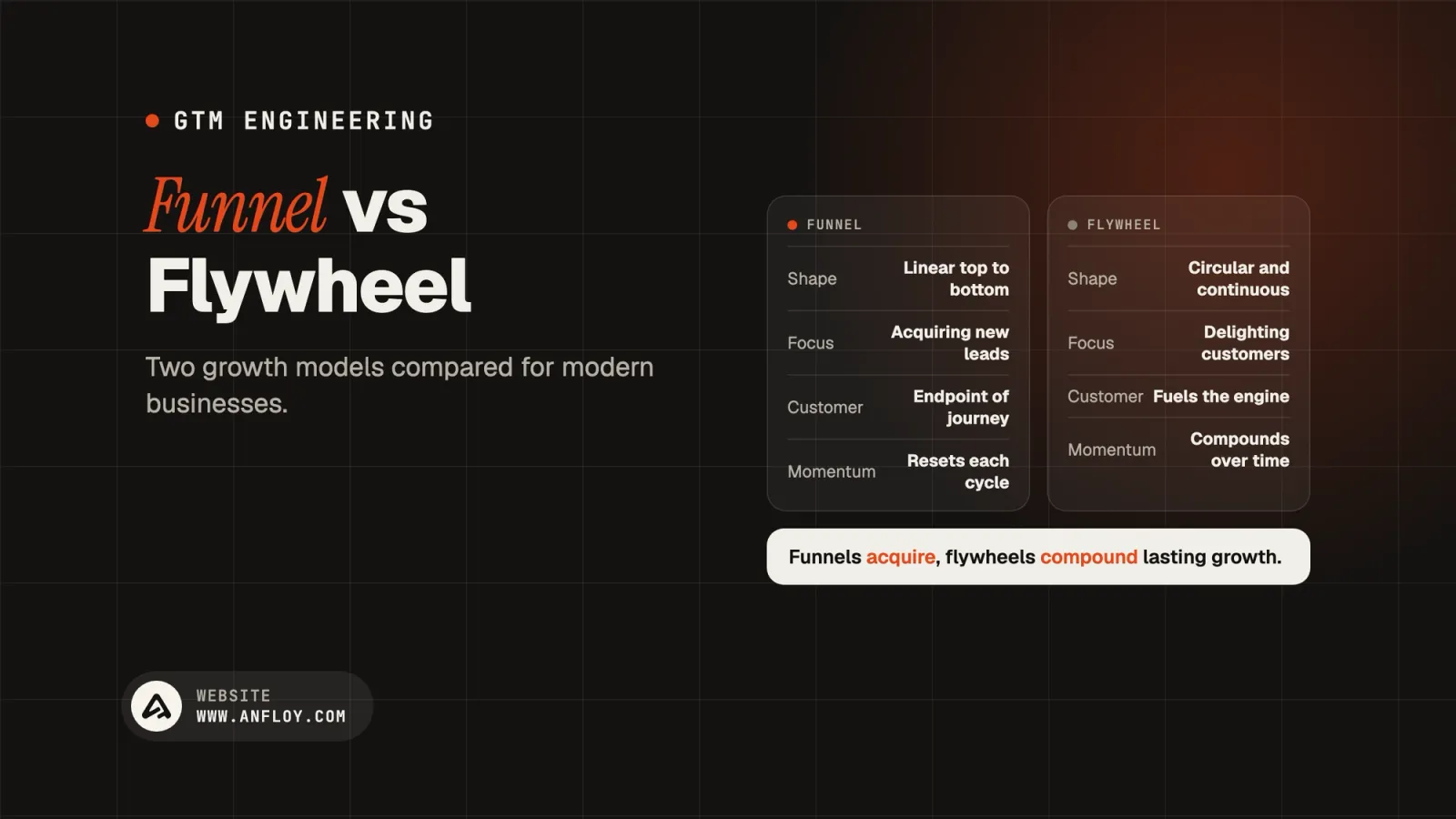
The comparison below highlights the differences.
| Marketing Funnel | Marketing Flywheel |
|---|---|
| Linear journey | Continuous cycle |
| Sale is the end | Customer is the center |
| Focus on acquisition | Focus on customer experience |
| Marketing drives growth | Entire organization drives growth |
| Customers exit after purchase | Customers remain part of growth |
| Measures conversions | Measures lifetime value |
| Optimizes lead generation | Optimizes customer success |
| Limited referrals | Customer advocacy fuels growth |
The marketing flywheel vs funnel debate isn't about replacing one model with another.
Instead, it's about recognizing that long-term growth depends on what happens after the sale not just before it.
Sales funnel vs flywheel
The distinction becomes even clearer when viewed through a sales perspective.
A traditional sales funnel focuses on converting prospects into customers.
The flywheel focuses on creating customers who generate future customers.
Traditional sales funnel
A sales funnel commonly follows these stages:
Prospect
    │
    ▼
Qualified Lead
    │
    ▼
Opportunity
    │
    ▼
Proposal
    │
    ▼
Closed Won
Sales teams typically measure:
- Win rate
- Conversion rate
- Pipeline value
- Sales cycle length
- Revenue
Once a deal closes, the funnel has effectively achieved its objective.
Flywheel sales model
In a flywheel-based organization, closing a deal represents the beginning of the customer relationship.
The journey looks more like this:

Acquire
    │
    ▼
Activate
    │
    ▼
Adopt
    │
    ▼
Expand
    │
    ▼
Advocate
         │
         └──────────────► New Customers
Success is measured through:
- Product adoption
- Customer satisfaction
- Renewal rates
- Expansion revenue
- Net Revenue Retention (NRR)
- Customer Lifetime Value (LTV)
- Referral growth
Rather than maximizing transactions, the objective is maximizing long-term customer value.
This is why many SaaS businesses increasingly prefer the flywheel approach.
Funnel vs flywheel: Side-by-side comparison
The following table summarizes the most important differences between the two growth models.
| Category | Funnel | Flywheel |
|---|---|---|
| Growth Model | Linear | Circular |
| Customer Journey | Ends after purchase | Continues after purchase |
| Primary Focus | Acquisition | Customer success and retention |
| Customer Role | Buyer | Growth driver |
| Revenue Source | New customers | New and existing customers |
| Marketing Objective | Generate leads | Build lasting relationships |
| Sales Objective | Close deals | Build customer value |
| Customer Success | Secondary | Central |
| Business Perspective | Campaign-centric | Customer-centric |
| Metrics | Conversion rate, CAC | LTV, NRR, retention, advocacy |
| AI Role | Lead qualification | Personalization and lifecycle automation |
| Scalability | Limited by acquisition | Compounds through advocacy |
This comparison illustrates why businesses increasingly discuss funnel vs flywheel when evaluating modern growth strategies.
HubSpot flywheel vs funnel
One of the biggest reasons the flywheel gained widespread attention is HubSpot's decision to replace the traditional funnel with a customer-centric growth model.
HubSpot argued that the funnel no longer reflected how modern businesses grow.
In the traditional model:
- Marketing generates leads.
- Sales closes deals.
- Customers exit the process.
This structure overlooks the influence existing customers have on future growth.
Instead, HubSpot proposed a flywheel where customers remain at the center of the business.
Every interaction contributes to momentum or friction.
Why HubSpot made the shift?
Several factors influenced this transition.
Customers influence future revenue
Happy customers:
- Refer new prospects
- Write reviews
- Participate in communities
- Purchase additional products
- Renew subscriptions
Their value extends well beyond the initial sale.
Customer experience became a competitive advantage
Modern buyers compare businesses based on:
- Ease of onboarding
- Support quality
- Product usability
- Responsiveness
- Educational resources
- Overall customer experience
Organizations delivering exceptional experiences naturally create stronger momentum.
Cross-functional alignment matters
Growth is no longer driven solely by marketing or sales.
It requires collaboration across:
- Marketing
- Sales
- Customer Success
- Revenue Operations
- Product
- Support
Every team contributes to reducing friction and increasing customer satisfaction.
AI makes the flywheel more powerful
Artificial intelligence helps organizations strengthen every stage of the flywheel by:
- Personalizing customer experiences
- Predicting churn
- Recommending next-best actions
- Automating customer support
- Improving lead qualification
- Accelerating onboarding
Rather than replacing the flywheel, AI amplifies its momentum.
Is the funnel obsolete?
Despite the popularity of the flywheel, the traditional funnel is far from outdated.
Funnels remain highly effective for:
- Campaign measurement
- Lead generation
- Conversion optimization
- Sales forecasting
- Pipeline management
- Marketing attribution
The real opportunity lies in combining both models.
Many organizations use the funnel to acquire customers and the flywheel to retain, expand, and delight them.
This hybrid approach provides a more complete view of the customer lifecycle and supports sustainable, long-term growth.
What are the benefits of the marketing funnel?
Despite the growing popularity of the flywheel model, the traditional marketing funnel continues to provide significant value for many organizations.
Its structured approach makes it particularly useful for measuring customer acquisition and optimizing sales performance.
Clear visibility into the buyer's journey
A funnel divides the customer journey into measurable stages.
This allows businesses to answer questions such as:
- How many visitors become leads?
- Where are prospects dropping off?
- Which campaigns generate the highest-quality leads?
- Which channels produce the best conversion rates?
By understanding each stage, marketing and sales teams can identify bottlenecks and improve overall performance.
Easier campaign measurement
Marketing funnels simplify performance reporting.
Teams can track metrics such as:
- Website traffic
- Click-through rate (CTR)
- Landing page conversion rate
- Marketing Qualified Leads (MQLs)
- Sales Qualified Leads (SQLs)
- Opportunity creation
- Customer Acquisition Cost (CAC)
- Return on Ad Spend (ROAS)
These metrics help organizations optimize marketing budgets and improve campaign efficiency.
Better sales forecasting
Sales leaders often rely on funnel stages to predict future revenue.
Because every opportunity moves through a structured pipeline, organizations can estimate:
- Expected revenue
- Win probability
- Sales cycle length
- Pipeline health
- Quota attainment
This makes the funnel especially valuable for enterprise sales teams with long buying cycles.
Simple to implement
Most CRM platforms are designed around funnel stages.
Businesses can quickly create pipelines for:
- Lead qualification
- Opportunity management
- Proposal tracking
- Closed deals
This simplicity explains why the funnel remains one of the most widely adopted business frameworks.
What are the benefits of the marketing flywheel?
The marketing flywheel expands the focus beyond acquisition by treating customers as an ongoing source of growth.
Rather than optimizing individual transactions, it strengthens the entire customer lifecycle.
Stronger customer retention
Acquiring new customers is expensive.
Keeping existing customers is often far more profitable.
The flywheel encourages organizations to invest in:
- Customer onboarding
- Product education
- Customer Success
- Support
- Continuous engagement
These activities improve satisfaction and reduce customer churn.
Higher customer lifetime value (LTV)
Customers who remain engaged are more likely to:
- Renew subscriptions
- Upgrade plans
- Purchase additional products
- Expand usage
- Recommend the business
Instead of maximizing a single transaction, businesses maximize long-term customer value.
More customer advocacy
One of the flywheel's greatest strengths is turning satisfied customers into advocates.
Happy customers naturally:
- Write reviews
- Refer colleagues
- Share experiences on social media
- Recommend products within their networks
- Participate in customer communities
These activities generate organic growth while reducing customer acquisition costs.
Better cross-functional alignment
The flywheel encourages collaboration across departments.
Instead of optimizing isolated functions, organizations work together to improve customer experiences.
Teams involved include:
- Marketing
- Sales
- Customer Success
- Revenue Operations
- Product
- Support
Every department contributes to creating momentum.
Supports subscription and SaaS business models
The flywheel aligns particularly well with recurring revenue businesses.
Subscription companies depend on:
- Renewals
- Expansion revenue
- Product adoption
- Customer health
- Net Revenue Retention (NRR)
These factors are naturally represented within a flywheel but receive little attention in traditional funnel models.
Funnel vs Flywheel: Which is better?
There is no universal winner.
The better model depends on your business model, customer journey, and growth objectives.
Instead of asking whether the flywheel vs funnel debate has a single answer, organizations should ask which framework best supports their strategy.
The following scenarios provide a practical guide.
When the funnel works best?
The funnel is often the stronger choice for businesses focused primarily on customer acquisition and transactional sales.
It performs particularly well when the buying journey has a clear beginning and end.
Examples include:
- E-commerce stores
- Real estate agencies
- Insurance providers
- Automotive dealerships
- One-time consulting projects
- Event ticket sales
- Retail businesses
These businesses prioritize generating new customers and maximizing conversion rates.
The traditional funnel provides the visibility needed to optimize those activities.
When the flywheel works best?
The flywheel is generally a better fit for businesses that depend on long-term customer relationships.
Examples include:
- SaaS companies
- B2B software providers
- Subscription services
- Product-Led Growth (PLG) businesses
- Managed service providers
- Customer Success-led organizations
- AI software companies
Their growth depends on:
- Renewals
- Customer retention
- Expansion revenue
- Referrals
- Product adoption
Because these businesses earn revenue throughout the customer lifecycle, the flywheel reflects their growth model more accurately.
Can businesses use both?
Absolutely.
In fact, many high-performing organizations combine both frameworks rather than choosing one.
A practical approach looks like this:

Marketing Funnel
        │
Generate Awareness
        │
Capture Leads
        │
Convert Customers
        │
───────────────
        ▼
Marketing Flywheel
        │
Onboard Customers
        │
Drive Product Adoption
        │
Deliver Customer Success
        │
Encourage Advocacy
        │
Generate New Demand
In this hybrid model:
- The funnel measures acquisition.
- The flywheel manages retention and expansion.
- Together, they create a complete customer lifecycle strategy.
This approach has become increasingly common among SaaS companies and modern B2B organizations.
How AI is transforming the funnel and flywheel?
Artificial intelligence is changing how businesses implement both growth models.
Rather than replacing either framework, AI enhances decision-making, personalization, and operational efficiency.
AI in the marketing funnel
AI improves every stage of customer acquisition.
Examples include:
- Predictive lead scoring
- Intelligent audience segmentation
- Personalized advertising
- AI-generated content
- Dynamic landing pages
- Chatbots for lead qualification
- Automated email nurturing
These capabilities help businesses attract higher-quality leads while improving conversion rates.
AI in the marketing flywheel
Within the flywheel, AI extends beyond acquisition to optimize the entire customer lifecycle.
Organizations increasingly use AI to:
- Personalize onboarding experiences
- Recommend relevant features
- Predict customer churn
- Automate customer support
- Deliver proactive success recommendations
- Generate customer health insights
- Identify expansion opportunities
AI helps organizations reduce friction while creating more valuable customer experiences.
What is the role of revenue operations and GTM engineering?
Modern businesses increasingly combine AI with Revenue Operations (RevOps) and GTM Engineering to maximize the effectiveness of the flywheel.
For example, GTM Engineers build systems that:
- Automatically route leads
- Synchronize CRM data
- Trigger onboarding workflows
- Connect marketing and sales platforms
- Power AI-driven customer journeys
- Automate lifecycle communications
Meanwhile, Revenue Operations teams ensure that marketing, sales, and customer success work from the same data and processes.
Together, these disciplines create a scalable, customer-centric growth engine that supports both the funnel and the flywheel.
Common mistakes when choosing between funnel and flywheel
Many organizations misunderstand how these frameworks should be applied.
Avoid these common mistakes.
Assuming the funnel is outdated
The funnel remains one of the best tools for measuring acquisition and sales performance.
It continues to play an important role in marketing analytics and revenue forecasting.
Ignoring existing customers
Businesses often spend heavily on acquiring new customers while neglecting those they already have.
Retention, expansion, and advocacy frequently deliver higher long-term returns than acquisition alone.
Measuring only conversion rates
Conversions matter but they don't tell the complete story.
Organizations should also monitor:
- Customer Lifetime Value (LTV)
- Net Revenue Retention (NRR)
- Customer Satisfaction (CSAT)
- Net Promoter Score (NPS)
- Product adoption
- Churn rate
These metrics provide a more comprehensive view of sustainable growth.
Treating departments as silos
Growth doesn't belong exclusively to marketing or sales.
Customer success, product, support, Revenue Operations, and GTM Engineering all contribute to improving customer experiences and reducing friction.
Cross-functional collaboration is essential for a successful flywheel.
How Anfloy helps?
At Anfloy, we help businesses move beyond disconnected funnels by building intelligent go-to-market systems that support the entire customer lifecycle.
Our expertise includes:
- GTM Engineering
- Revenue Operations
- CRM architecture
- Workflow automation
- AI implementation
- Revenue Intelligence
- Customer lifecycle automation
- API integrations
Whether your organization is optimizing a traditional sales funnel, adopting a customer-centric flywheel, or combining both models, we help build scalable systems that reduce friction and accelerate sustainable growth.
Conclusion
The debate around funnel vs flywheel isn't about declaring one model obsolete. Instead, it's about recognizing that modern growth requires both efficient customer acquisition and exceptional customer experiences.
The traditional funnel remains invaluable for generating leads, measuring conversions, and forecasting revenue. The marketing flywheel extends that journey by focusing on retention, customer success, advocacy, and long-term momentum.
For many organizations, the most effective strategy is not choosing between the two but combining them. A funnel brings customers into the business, while a flywheel keeps them engaged, encourages expansion, and transforms satisfied customers into your most powerful growth channel.
As AI, Revenue Operations, and GTM Engineering continue to reshape modern go-to-market strategies, businesses that reduce friction across the entire customer lifecycle will be better positioned for sustainable growth.
Build a modern growth engine with Anfloy
Customer acquisition is only the beginning of sustainable growth.
Anfloy helps businesses connect marketing, sales, customer success, and AI through GTM Engineering, Revenue Operations, CRM architecture, workflow automation, and Revenue Intelligence.
Whether you're optimizing a traditional funnel or building a customer-first flywheel, we help create scalable systems that accelerate growth at every stage of the customer lifecycle.
Book you call
Frequently Asked Questions
What is the difference between a funnel and a flywheel?
A funnel focuses on moving prospects toward a purchase, while a flywheel focuses on creating continuous growth by keeping customers engaged, satisfied, and willing to advocate for your brand.
Is the flywheel replacing the funnel?
Not entirely. Many organizations continue using the funnel for customer acquisition while relying on the flywheel to improve retention, customer success, and long-term growth.
What is HubSpot's flywheel?
HubSpot's flywheel is a customer-centric growth model built around three stages Attract, Engage, and Delight. It emphasizes reducing friction and creating momentum through exceptional customer experiences.
Which model is better for SaaS companies?
The flywheel generally aligns better with SaaS because recurring revenue depends on retention, renewals, product adoption, and customer advocacy. However, SaaS businesses still use funnels to measure acquisition performance.
Can businesses use both a funnel and a flywheel?
Yes. Many organizations use the funnel to acquire customers and the flywheel to retain, expand, and delight them. This hybrid approach provides a complete view of the customer lifecycle.
How does AI improve the flywheel?
AI reduces friction by personalizing customer experiences, predicting churn, automating support, recommending next-best actions, and improving customer success throughout the lifecycle.
Let's build
what your
company needs.
Drop your email. We'll send The Custom Agent Blueprint on what we'd build first for a company like yours, before you ever take a meeting.