
GTM Engineering Use Cases: Where the Discipline Actually Pays Off
A practical breakdown of real GTM engineering use cases across marketing, sales, RevOps, and customer success, with what each one requires and how to prioritize where to start.
On this page
- What counts as a GTM engineering use case?
- Marketing and demand generation use cases
- Sales and SDR use cases
- RevOps use cases
- Customer success and retention use cases
- A summary table of use cases by impact and build complexity
- How to prioritize which use case to build first?
- Common mistakes when choosing use cases
- A worked example: Sequencing three use cases
- How Anfloy helps teams pick and build the right use cases?
- Conclusion
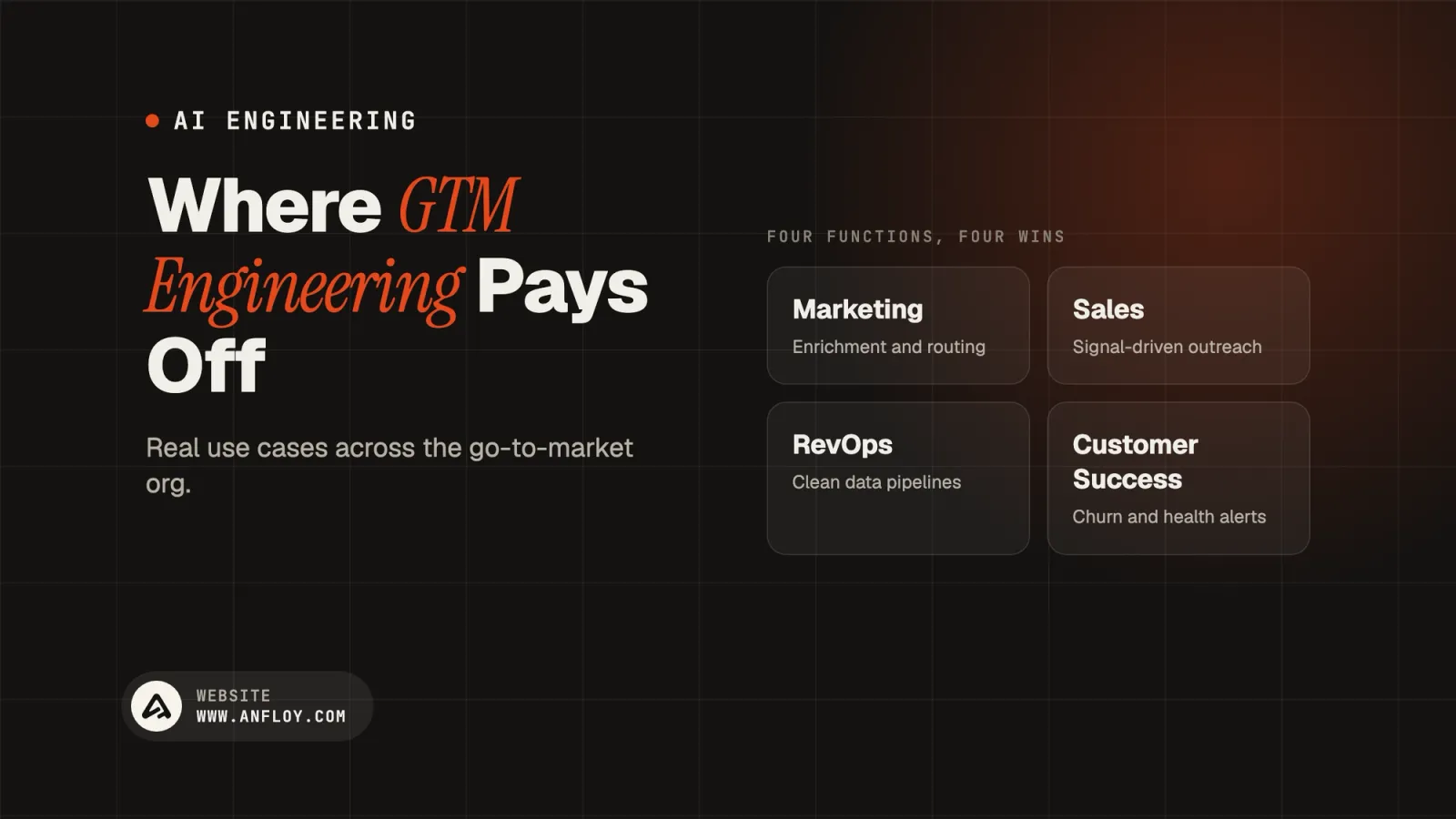
"GTM engineering" can sound abstract until it's attached to something concrete: a lead that used to sit unrouted for hours now reaching the right rep in under a minute, a CRM that used to require an hour of manual cleanup a week now staying accurate on its own, a renewal that used to catch a customer success manager by surprise now flagged three weeks out.
The discipline earns its keep in specific, narrow use cases, not as a vague company-wide initiative.
This guide breaks down the real use cases where GTM engineering consistently produces measurable results, organized by function, along with what each one actually requires to build and how to prioritize which one to tackle first.
What counts as a GTM engineering use case?
A GTM engineering use case is a specific, bounded problem in the revenue organization solved with a defined technical system, data pipeline, automation, or AI agent, rather than a broad transformation initiative with no clear edges.
"Improve our sales process" isn't a use case. "Automatically enrich and score every inbound lead within two minutes of form submission" is, precise enough to scope, build, and measure against a before-and-after.
This precision matters because it's what separates GTM engineering from GTM strategy more broadly.
Strategy sets direction; a use case is a specific, buildable unit of that strategy, the same distinction covered in more depth in what GTM engineering actually is and in GTM workflows as the operational layer beneath any strategy.
Marketing and demand generation use cases
Signal-based lead prioritization
Instead of treating every inbound lead equally, this use case scores and prioritizes leads based on live buying signals, a pricing page visit, a competitor comparison search, a relevant job change at the account, rather than static firmographic fit alone.
It requires a signal detection layer feeding into a scoring model, the mechanics of which are covered in signal-based prospecting.
Automated content-to-lead attribution
Connecting which specific content, page, or campaign a lead engaged with before converting, tracked at the account level rather than relying on last-touch attribution alone, so marketing can see which content actually correlates with pipeline rather than just form fills.
Dynamic audience segmentation for outbound
Building segments that update automatically as account data changes, rather than static lists exported once and left stale, so a campaign targeting "companies that recently raised funding" actually reflects current data instead of a snapshot from weeks earlier.
Sales and SDR use cases
Automated lead enrichment and scoring
The foundational use case most GTM engineering programs start with: appending firmographic and contact data to every new lead automatically, then scoring it against defined ICP criteria before a rep ever sees it, the same discipline covered in AI for CRM data enrichment and lead scoring.
Intelligent lead routing
Assigning a scored, enriched lead to the right rep based on territory, existing account ownership, and capacity, within a defined response-time SLA, rather than relying on a rep to notice a new lead in a shared queue. Covered in full in how to build a lead routing system.
AI-assisted personalized outreach
Generating a first-touch message grounded in a specific signal or account context, rather than a templated field-merge, and flagging low-confidence outputs for human review before sending.
The mechanics are covered in personalized outbound systems.
Meeting-to-CRM automation
Automatically extracting structured data, stakeholders, objections, next steps, budget signals, from a call transcript and writing it directly into the relevant CRM record before a rep has to log notes manually, closing one of the most common CRM data-quality gaps.
Deal-risk monitoring
Scoring open opportunities against defined risk signals, stalled engagement, stage age versus benchmark, sentiment shifts in recent replies, and surfacing specific, actionable briefs before a rep's weekly pipeline review rather than relying on memory, covered further in AI for pipeline management.
RevOps use cases
CRM data hygiene automation
Continuously validating and standardizing CRM fields, deduplicating records, flagging stale or missing data, rather than relying on a periodic manual cleanup project that's out of date again within weeks.
This underpins nearly every other use case on this list, since none of them work reliably on top of dirty data.
Forecast rollup automation
Pulling deal-level data into a consistent forecast view automatically, rather than reps updating a spreadsheet manually each week, reducing both the manual effort and the version-control confusion that comes with several people editing the same forecast independently.
Tool and system reconciliation
Identifying and resolving conflicts between systems that each hold a partial version of the same account or contact record, a common problem covered in more depth in composable data architecture for GTM stacks, where multiple point tools drift out of sync without a shared source of truth.
Revenue intelligence dashboards
Surfacing patterns across the full funnel, which segments convert best, where deals stall most often, which reps or channels are outperforming, pulled automatically from live data rather than assembled manually before each leadership review, the broader discipline covered in AI revenue intelligence.
Customer success and retention use cases
Usage-based expansion signal detection
Identifying accounts showing real expansion signals, a team hitting a seat limit, usage growing meaningfully past historical baseline, and routing them to the right owner before the opportunity is discovered by accident during a renewal conversation.
Churn risk scoring
Flagging accounts showing early warning signs, usage decline, a drop in login frequency, a support escalation pattern, well before a renewal date, giving a customer success manager enough runway to actually intervene rather than finding out at the eleventh hour.
Automated onboarding progress tracking
Monitoring whether a new customer is actually hitting defined activation milestones after close, and triggering an alert or a check-in when they stall, rather than assuming onboarding is on track until someone happens to ask.
A summary table of use cases by impact and build complexity
| Use case | Function | Typical build complexity | Typical impact |
|---|---|---|---|
| Lead enrichment and scoring | Sales | Low to moderate | High, foundational for most other use cases |
| Lead routing | Sales | Moderate | High, direct effect on response time and conversion |
| CRM data hygiene | RevOps | Moderate | High, underpins reliability of everything downstream |
| Deal-risk monitoring | Sales | Moderate | Moderate to high, depends on pipeline volume |
| Signal-based prioritization | Marketing | Moderate to high | High for outbound-heavy motions |
| Personalized outreach generation | Sales | Moderate to high | Moderate to high, depends on message quality |
| Meeting-to-CRM automation | Sales | Moderate | Moderate, meaningful time savings, less direct revenue impact |
| Churn risk scoring | Customer Success | Moderate to high | High for retention-dependent businesses |
| Forecast rollup automation | RevOps | Low to moderate | Moderate, mostly efficiency gain |
| Revenue intelligence dashboards | RevOps | High | Moderate to high, depends on how actionable the output is |
How to prioritize which use case to build first?
The instinct to start with the most ambitious use case, usually a full signal-to-close system, is almost always the wrong instinct for a first build.
The stronger approach weighs two factors against each other: how much friction the current manual or broken version of this process actually causes today, and how quickly a working version could realistically ship.
A useful filter for a first build: pick the use case where the current manual process is a clear, acknowledged pain point, where the data needed to build it already exists somewhere even if it's not connected yet, and where success can be measured cleanly within a month.
Lead enrichment and scoring, or CRM data hygiene, tend to fit this filter well for most companies, because they're foundational enough that nearly every other use case on this list benefits from them being solid first, and narrow enough to ship quickly.
Use cases spanning multiple systems and requiring more judgment-based AI reasoning, personalized outreach generation, churn scoring, deal-risk monitoring, tend to be stronger second or third builds, once there's a working data foundation underneath them and a track record of one system actually running reliably in production.
Not sure which use case would move the needle most for your team? Get a free AI infrastructure audit and we'll help you prioritize.
Common mistakes when choosing use cases
Starting with the most visible use case instead of the most foundational one.
Personalized AI outreach is the flashiest use case on this list, but it performs poorly built on top of dirty enrichment data, which means teams that start there often end up rebuilding the foundation underneath a system they already shipped.
Trying to solve every function at once.
A use case spanning marketing, sales, and customer success simultaneously is harder to scope, harder to own, and harder to debug than three narrower use cases built and proven independently first.
Picking a use case based on what's trending rather than where the actual friction is.
The right first use case is wherever your team already complains the most, not whichever use case is getting the most attention in the AI agent conversation generally.
No plan for who owns the use case once it's live.
A use case without a named owner tends to degrade quietly over time, the same ownership gap covered in GTM workflows more broadly.
Underestimating how much a use case depends on data quality that doesn't exist yet.
Several of the more advanced use cases on this list, deal-risk monitoring, churn scoring, assume clean, consistent underlying data that many companies don't actually have until a data hygiene use case has been solved first.
A worked example: Sequencing three use cases
A company decides to invest in GTM engineering and starts with lead enrichment and scoring, since it's foundational and the current manual research process is a well-known pain point for the SDR team.
It ships in a few weeks, and every lead entering the pipeline now arrives enriched and scored automatically.
With that foundation in place, the second use case, intelligent lead routing, becomes meaningfully easier to build, since it can rely on clean scores and enriched account data rather than needing to solve data quality and routing logic simultaneously.
It ships faster than the first use case did, because half the groundwork was already laid.
By the third use case, personalized outreach generation, the team has both clean data and a working routing system to plug into, so the outreach workflow only has to solve the actual hard problem, generating a good message, rather than also solving data and routing gaps along the way.
Sequencing use cases this way, foundational first, judgment-heavy last, is consistently faster in aggregate than attempting all three from a standing start simultaneously.
How Anfloy helps teams pick and build the right use cases?
Anfloy starts every engagement by mapping which use cases would actually move the needle for a specific business, not a generic list of what's possible with AI.
We weigh current friction against build complexity the same way outlined above, and we're honest when a smaller, foundational use case is the right first build even when a client initially asked for something more ambitious, because sequencing matters more than starting big.
Every use case we build ships as infrastructure you own outright, designed to be the foundation the next use case builds on rather than a standalone system disconnected from what comes after it, the same end-to-end thinking behind how to build a GTM AI stack.
Want an honest read on which use case to build first? See how our process works before scoping anything.
Conclusion
GTM engineering earns its value one specific use case at a time, not as an abstract company-wide transformation.
The teams getting real results aren't chasing the most sophisticated system possible, they're sequencing use cases deliberately, starting with the foundational ones that make every subsequent build easier, and matching each one to where the actual friction in their business already is.
Ready to map out which GTM engineering use cases actually fit your team? Book a call, no decks, no demos, just a working session on where to start.
Frequently Asked Questions
What's the single most common GTM engineering use case companies start with?
Lead enrichment and scoring, by a wide margin. It's foundational to nearly every other use case, the current manual alternative is a well-understood pain point almost every sales team recognizes, and it can typically ship and show measurable results within a few weeks.
Do all these use cases require AI, or is some of it just automation?
A meaningful share is deterministic automation, CRM data hygiene, forecast rollups, meeting-to-CRM field extraction using structured transcripts, rather than AI reasoning. The use cases genuinely requiring AI judgment are the ones involving interpretation: personalized messaging, sentiment-based deal risk, churn signal classification from unstructured data.
How long does a typical GTM engineering use case take to build?
It varies by complexity, but a well-scoped, foundational use case like lead enrichment and scoring is often achievable in a few weeks. More advanced, judgment-heavy use cases spanning multiple systems, like deal-risk monitoring or churn scoring, typically take longer and benefit from a solid data foundation already being in place first.
Should a small company attempt all of these use cases eventually?
Not necessarily all of them, and rarely all at once. The right set of use cases depends on where a specific business's actual friction is. A company without a churn problem doesn't need churn risk scoring; a company running mostly inbound doesn't need the same signal-based outbound infrastructure a heavy outbound motion would.
What's the biggest risk in choosing a GTM engineering use case?
Picking based on ambition or trend rather than actual current friction and data readiness. The use cases that fail most often aren't badly built, they're built on a foundation, usually clean data or a working upstream process, that wasn't actually in place yet when the build started.
Let's build
what your
company needs.
Drop your email. We'll send The Custom Agent Blueprint on what we'd build first for a company like yours, before you ever take a meeting.