
RevOps vs Sales Ops vs GTM Engineering: What's the Difference?
Understand how Revenue Operations, Sales Operations, and GTM Engineering differ in responsibilities, tech stacks, salaries, and business value.
On this page
- What is revenue operations (RevOps)?
- What is sales operations?
- What is GTM engineering?
- RevOps vs Sales Ops vs GTM engineering
- How these teams work together?
- Responsibilities compared
- What are the top skills required for each role?
- Tech stack comparison
- Which role should your company hire?
- Which career path is right for you?
- Salary comparison
- How AI is transforming these roles?
- Common misconceptions
- How Anfloy helps?
- Conclusion
As companies scale, their go-to-market (GTM) organizations become increasingly complex.
Marketing generates leads, sales convert opportunities, customer success retains accounts, and leadership expects predictable revenue growth. Behind these customer-facing teams are operational professionals responsible for building the systems, processes, and technology that keep revenue flowing efficiently.
Three roles often appear in this conversation:
- Revenue Operations (RevOps)
- Sales Operations (Sales Ops)
- GTM Engineering
Although they're closely related, they serve different purposes.
Many organizations use these titles interchangeably, while others create overlapping responsibilities that lead to confusion. For professionals exploring career opportunities or business leaders planning new hires, understanding the differences is essential.
Revenue Operations focuses on aligning the entire revenue organization.
Sales Operations specializes in optimizing sales performance.
GTM Engineering builds the technology, automation, integrations, and AI systems that power modern revenue teams.
As businesses adopt AI, automation, and increasingly sophisticated revenue technology, GTM Engineering has emerged as one of the fastest-growing functions, working alongside RevOps and Sales Ops rather than replacing them.
Whether you're evaluating your next career move or deciding how to structure your revenue organization, this comparison will help you understand where each role fits.
What is revenue operations (RevOps)?
Revenue Operations, commonly called RevOps, is a strategic business function responsible for aligning every revenue-generating department.
Instead of optimizing one team in isolation, RevOps ensures that marketing, sales, customer success, finance, and leadership work from the same data, processes, and performance metrics.
Its ultimate goal is simple:
Increase predictable revenue by improving operational alignment across the entire customer lifecycle.
Rather than owning individual sales activities, RevOps focuses on creating systems that improve how departments collaborate.
What are the core responsibilities of RevOps?
A Revenue Operations team typically manages:
- Revenue strategy
- Cross-functional process design
- CRM governance
- Pipeline management
- Revenue forecasting
- Lifecycle management
- Customer journey optimization
- Reporting and dashboards
- Data governance
- Performance measurement
RevOps professionals frequently work with executives to identify operational bottlenecks that slow company growth.
What are the key objectives of RevOps?
The success of RevOps is measured through company-wide outcomes rather than individual department metrics.
Common objectives include:
- Better alignment between marketing and sales
- Higher forecast accuracy
- Improved customer retention
- Faster sales cycles
- Better pipeline visibility
- More predictable revenue growth
- Consistent customer experiences
Because RevOps spans multiple departments, professionals spend considerable time collaborating with leadership teams.
What are typical RevOps KPIs?
Examples include:
- Annual Recurring Revenue (ARR)
- Monthly Recurring Revenue (MRR)
- Pipeline coverage
- Customer Lifetime Value (LTV)
- Customer Acquisition Cost (CAC)
- Win rate
- Revenue growth
- Forecast accuracy
- Sales velocity
- Net Revenue Retention (NRR)
These metrics provide executives with a comprehensive view of business performance.
What is sales operations?
Sales Operations focuses specifically on improving the efficiency and effectiveness of the sales organization.
Unlike RevOps, which supports the entire revenue engine, Sales Operations concentrates on helping sales representatives spend more time selling and less time managing administrative work.
Its primary mission is to remove friction from the sales process.
What are the core responsibilities of sales operations?
Sales Operations professionals commonly manage:
- Sales process optimization
- Territory planning
- Sales forecasting
- Quota management
- CRM maintenance
- Sales reporting
- Compensation planning
- Pipeline hygiene
- Sales enablement support
- Performance tracking
Everything revolves around improving sales productivity.
What are daily activities of sales operation manger?
A Sales Operations manager might spend the day:
- Updating dashboards
- Assigning leads
- Monitoring pipeline quality
- Building sales reports
- Managing quotas
- Supporting CRM users
- Improving sales workflows
The work is highly tactical while still contributing to broader business goals.
What are best sales operations KPIs?
Typical performance indicators include:
- Quota attainment
- Sales productivity
- Pipeline health
- Deal velocity
- Average deal size
- Conversion rates
- Sales cycle length
- Activity metrics
- Forecast accuracy
Unlike RevOps, Sales Operations measures success primarily within the sales organization.
What is GTM engineering?
GTM Engineering is a modern operational discipline that combines technology, automation, artificial intelligence, integrations, and Revenue Operations to build scalable go-to-market systems.
Rather than focusing solely on strategy or sales performance, GTM Engineers design the infrastructure that powers the entire revenue engine.
Think of GTM Engineering as the technical layer connecting every revenue platform.
A GTM Engineer may build systems that automatically:
- Capture website leads
- Route prospects to sales teams
- Enrich CRM records
- Trigger AI workflows
- Launch personalized outreach
- Update dashboards
- Notify internal teams
- Generate executive reports
Instead of manually managing operations, GTM Engineers automate them.
What are the core responsibilities of GTM engineering?
Typical responsibilities include:
- CRM architecture
- Workflow automation
- API integrations
- AI implementation
- Data synchronization
- Revenue system design
- AI agent deployment
- Automation governance
- Reporting infrastructure
- Documentation
These professionals bridge the gap between operations and technology.
Why GTM engineering is growing so quickly
Several trends have accelerated demand for GTM Engineers:
- AI adoption
- Workflow automation
- Increasing software complexity
- Connected revenue systems
- Low-code platforms
- Revenue Intelligence
- Company AI Brains
Organizations no longer need someone to simply manage CRM records.
They need experts who can connect dozens of business systems into one intelligent revenue platform.
RevOps vs Sales Ops vs GTM engineering
The easiest way to understand these roles is to compare their primary responsibilities.
| Category | Revenue Operations | Sales Operations | GTM Engineering |
|---|---|---|---|
| Primary Focus | Revenue strategy | Sales efficiency | Revenue technology |
| Scope | Entire revenue organization | Sales department | Cross-functional technology |
| Main Goal | Revenue alignment | Sales productivity | Automation and system design |
| Primary Users | Marketing, Sales, CS, Leadership | Sales teams | Entire GTM organization |
| CRM Ownership | Governance | Daily usage and optimization | Architecture and automation |
| Automation | Medium | Low to Medium | High |
| AI Adoption | Growing | Emerging | Core responsibility |
| Technical Depth | Moderate | Moderate | High |
| API Integrations | Occasionally | Rarely | Frequently |
| Workflow Automation | Supports | Limited | Primary responsibility |
| Reporting | Executive reporting | Sales reporting | System-generated analytics |
| Success Metric | Revenue growth | Sales performance | Operational efficiency |
Although these roles overlap, their priorities differ significantly.
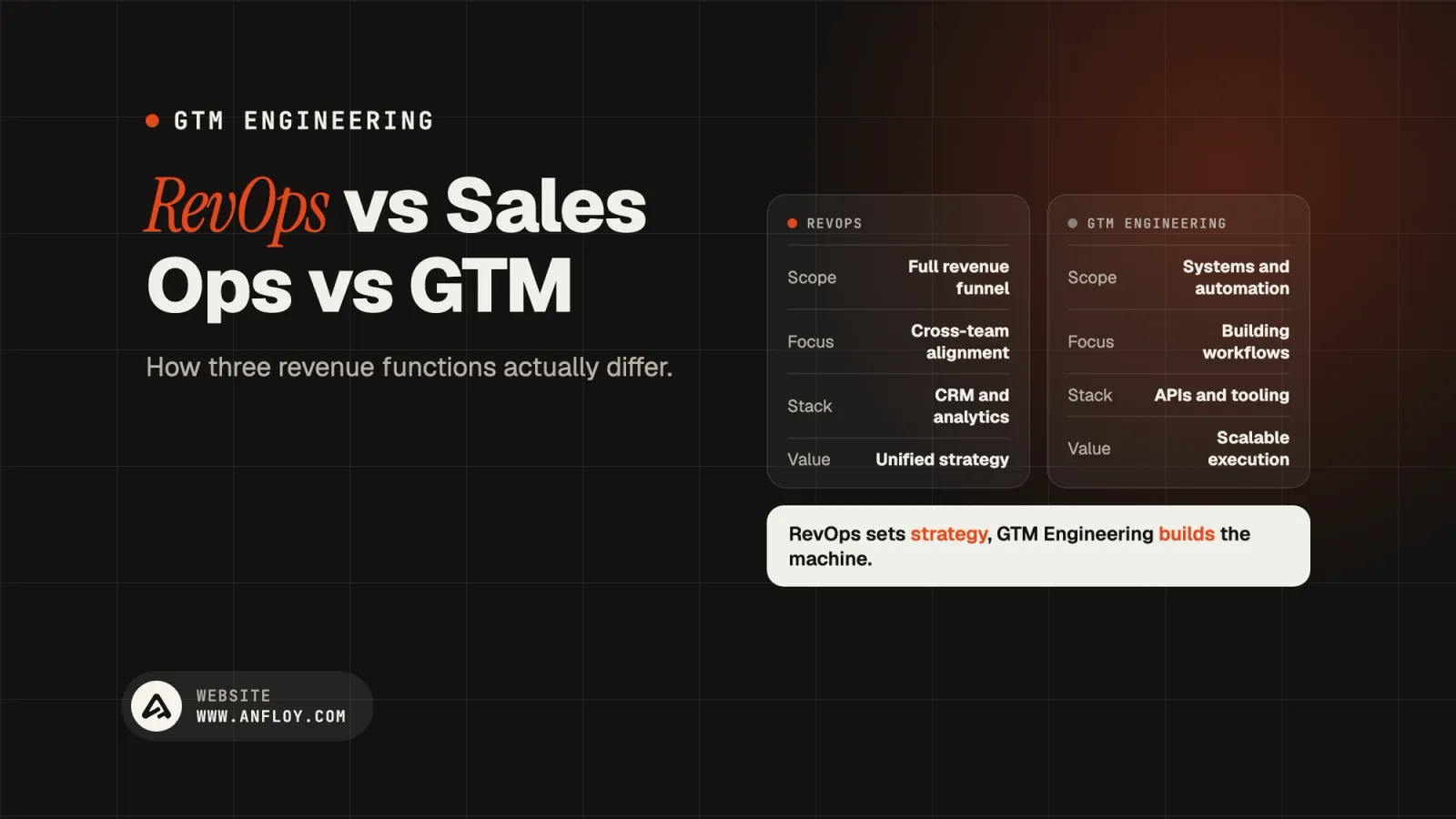
RevOps aligns people and processes.
Sales Ops optimizes selling.
GTM Engineering builds the technology that enables both.
How these teams work together?
A high-performing revenue organization doesn't choose between RevOps, Sales Ops, and GTM Engineering.
Instead, each function complements the others.
Chief Revenue Officer
                                  │
          ┌───────────────────────┼────────────────────────┐
          │                       │                        │
     Revenue Operations      Sales Operations      GTM Engineering
          │                       │                        │
          └───────────────Revenue Technology───────────────┘
                                  │
         Marketing • Sales • Customer Success • Leadership
For example:
- RevOps identifies that lead response times are slowing revenue growth.
- Sales Ops redesigns the lead assignment process.
- GTM Engineering builds the automation, CRM workflows, API integrations, and AI agents that execute the new process automatically.
Together, they create a more efficient and scalable revenue engine.
Responsibilities compared
Although RevOps, Sales Ops, and GTM Engineering often collaborate on the same initiatives, their day-to-day responsibilities are quite different. Understanding these differences helps organizations assign ownership correctly and avoid duplicated work.
Revenue operations responsibilities
Revenue Operations is responsible for optimizing the entire revenue engine.
Typical responsibilities include:
- Aligning marketing, sales, and customer success processes
- Defining the customer lifecycle
- Standardizing revenue metrics
- Managing forecasting processes
- Improving pipeline visibility
- Establishing CRM governance
- Creating executive dashboards
- Identifying operational bottlenecks
- Managing revenue planning
- Driving cross-functional alignment
RevOps professionals frequently work with executive leadership to improve how different departments contribute to revenue growth.
Sales operations responsibilities
Sales Operations focuses specifically on enabling sales teams to perform more efficiently.
Common responsibilities include:
- Managing sales territories
- Assigning inbound leads
- Maintaining CRM records
- Designing compensation plans
- Supporting sales forecasting
- Monitoring pipeline health
- Creating sales reports
- Managing quotas
- Improving sales processes
- Supporting sales managers with operational insights
Sales Operations acts as the operational backbone of the sales organization.
GTM engineering responsibilities
GTM Engineering owns the technical infrastructure behind modern revenue operations.
Responsibilities often include:
- Designing CRM architecture
- Building workflow automation
- Creating API integrations
- Implementing AI-powered workflows
- Managing system integrations
- Building AI agents
- Automating lead routing
- Deploying data enrichment
- Maintaining revenue infrastructure
- Creating scalable automation frameworks
Rather than managing people or quotas, GTM Engineers build systems that allow revenue teams to work more efficiently.
What are the top skills required for each role?
Each discipline requires a unique combination of technical expertise, business understanding, and communication skills.
Revenue operations skills
Technical Skills
- CRM administration
- Revenue analytics
- Forecasting
- Reporting
- Process optimization
Business Skills
- Strategic planning
- Revenue modeling
- Cross-functional collaboration
- Executive communication
- Customer lifecycle management
Soft Skills
- Leadership
- Stakeholder management
- Problem solving
- Analytical thinking
- Change management
Sales operations skills
Technical Skills
- CRM management
- Sales reporting
- Pipeline analysis
- Forecasting
- Spreadsheet modeling
Business Skills
- Sales methodology
- Territory management
- Compensation planning
- Sales enablement
- Performance analysis
Soft Skills
- Organization
- Communication
- Attention to detail
- Coaching
- Collaboration
GTM engineering skills
Technical Skills
- CRM architecture
- APIs
- Workflow automation
- AI implementation
- Data synchronization
- SQL fundamentals
- Webhooks
- Revenue systems
Business Skills
- Revenue Operations
- Marketing automation
- Customer lifecycle
- Sales processes
- SaaS metrics
Soft Skills
- Systems thinking
- Documentation
- Problem solving
- Continuous learning
- Cross-functional communication
One of the defining characteristics of GTM Engineering is the balance between technical implementation and business strategy.
Tech stack comparison
Although these functions may use many of the same platforms, they interact with them differently.
| Technology | RevOps | Sales Ops | GTM Engineering |
|---|---|---|---|
| HubSpot | Governance & reporting | Daily sales operations | CRM architecture & automation |
| Salesforce | Revenue management | Sales workflows | System design & integrations |
| GA4 | Revenue attribution | Limited usage | Event tracking & integrations |
| Looker Studio | Executive dashboards | Sales dashboards | Automated reporting |
| Zapier | Basic automation | Limited | Advanced workflow automation |
| n8n | Occasionally | Rare | Primary automation platform |
| Make | Workflow support | Rare | Multi-system orchestration |
| Clay | Revenue enrichment | Limited | AI-powered enrichment |
| Apollo | Revenue insights | Sales engagement | Workflow integrations |
| ChatGPT | Reporting assistance | Sales productivity | AI workflow development |
| Claude | Documentation | Limited | AI automation |
| Gemini | Research | Limited | AI-powered workflows |
The biggest difference isn't the software itself it's how each role uses the technology to achieve different business objectives.
Which role should your company hire?
The right hire depends on your company's stage, operational maturity, and business goals.
Early-Stage Startups
Primary challenges:
- Limited resources
- Manual processes
- Rapid growth
- Small teams
Recommended first hire:
GTM Engineering
Why?
Automation and scalable systems help startups avoid operational bottlenecks before they become expensive problems.
A GTM Engineer can:
- Build CRM infrastructure
- Automate lead management
- Connect marketing and sales tools
- Deploy AI workflows
- Reduce manual work
Growth-Stage Companies
Primary challenges:
- Scaling multiple teams
- Increasing revenue complexity
- Department alignment
- Forecast accuracy
Recommended hire:
Revenue Operations
RevOps helps coordinate the growing complexity across marketing, sales, and customer success while maintaining predictable revenue growth.
Enterprise Organizations
Large enterprises typically benefit from all three functions.
Example ownership:
Revenue Operations
- Revenue strategy
- Forecasting
- Executive reporting
- Cross-functional alignment
Sales Operations
- Sales productivity
- Territory management
- Pipeline optimization
- Sales enablement
GTM Engineering
- Automation
- AI implementation
- CRM architecture
- Integrations
- Revenue technology
Each team specializes while supporting shared business objectives.
Which career path is right for you?
Choosing between these careers depends on your interests and strengths.
| If you enjoy... | Best Career |
|---|---|
| Business strategy | Revenue Operations |
| Working closely with sales teams | Sales Operations |
| Technology and automation | GTM Engineering |
| AI implementation | GTM Engineering |
| Executive reporting | Revenue Operations |
| CRM optimization | Sales Operations or GTM Engineering |
| APIs and integrations | GTM Engineering |
| Forecasting | Revenue Operations |
| Workflow design | GTM Engineering |
There isn't a universally "better" career.
The best choice depends on whether you're energized by strategy, operational excellence, or technology.
Salary comparison
Although compensation varies by location, company size, and experience, GTM Engineering has emerged as one of the highest-paying operational career paths due to its combination of technical expertise and business impact.
| Role | Entry Level | Mid-Level | Senior |
|---|---|---|---|
| Sales Operations | $65K–$90K | $90K–$130K | $130K–$170K+ |
| Revenue Operations | $80K–$110K | $120K–$170K | $170K–$240K+ |
| GTM Engineering | $90K–$120K | $140K–$190K | $190K–$300K+ |
As AI adoption accelerates, professionals who can design intelligent automation and connect complex revenue systems are increasingly commanding premium compensation.
How AI is transforming these roles?
Artificial intelligence is reshaping every operational function but not in the same way.
AI in revenue operations
- Improve forecasting
- Predict churn
- Analyze revenue trends
- Surface operational insights
- Recommend strategic decisions
Their focus remains on improving business performance through better decision-making.
AI in sales operations
Sales Operations uses AI to:
- Prioritize leads
- Improve forecasting
- Analyze sales activity
- Coach sales representatives
- Automate administrative tasks
AI enables sales teams to spend more time engaging customers and less time on repetitive work.
AI in GTM engineering
For GTM Engineering, AI isn't simply another tool it's becoming a core part of the technology stack.
GTM Engineers increasingly build:
- AI-powered lead qualification
- AI routing systems
- Autonomous workflow agents
- Company AI Brains
- AI-driven CRM automation
- Intelligent customer lifecycle workflows
As organizations adopt agentic AI, GTM Engineers will play a central role in designing, integrating, and governing these systems.
Common misconceptions
"RevOps and Sales Ops are the same."
Not quite.
Sales Operations focuses exclusively on sales performance, while Revenue Operations supports the entire revenue organization.
"GTM Engineering is just CRM administration."
Modern GTM Engineering extends far beyond CRM management.
It includes automation, AI, APIs, workflow orchestration, data synchronization, and revenue system architecture.
"AI will replace these roles."
AI is more likely to automate repetitive operational tasks than eliminate these careers.
Professionals who understand how to implement and manage AI systems will become even more valuable.
"Small companies don't need operational specialists."
Even startups benefit from scalable CRM architecture, automation, and clear operational processes.
Investing early often prevents expensive inefficiencies later.
How Anfloy helps?
At Anfloy, we help organizations build modern go-to-market systems that combine Revenue Operations strategy with intelligent automation and GTM Engineering best practices.
Our expertise includes:
- CRM architecture
- Workflow automation
- AI implementation
- Revenue system design
- API integrations
- Company AI Brain development
- Revenue Intelligence
- Cross-functional GTM optimization
Whether you're modernizing existing operations or building a new revenue infrastructure from the ground up, GTM Engineering provides the technical foundation that enables sustainable growth.
Conclusion
Revenue Operations, Sales Operations, and GTM Engineering each play a distinct role in building a high-performing revenue organization.
Revenue Operations aligns strategy, processes, and performance across the entire customer lifecycle.
Sales Operations enables sales teams to operate more efficiently through better planning, reporting, and execution.
GTM Engineering designs the technology, automation, integrations, and AI systems that power modern go-to-market organizations.
Rather than competing with one another, these disciplines work best together. As businesses continue investing in AI and automation, organizations that combine strategic operational leadership with strong technical execution will be better positioned for sustainable growth.
Talk to Anfloy
Looking to modernize your go-to-market operations?
Anfloy helps businesses design scalable revenue systems through GTM Engineering, workflow automation, CRM architecture, AI implementation, and Revenue Operations consulting. Learn how we can help you build a connected, future-ready revenue engine.
Book your call
Frequently Asked Questions
Is GTM Engineering part of Revenue Operations?
In many organizations, GTM Engineering operates within the Revenue Operations team. However, as companies grow, it often becomes its own specialized function responsible for automation, integrations, CRM architecture, and AI implementation.
Which role pays the most?
While salaries vary, GTM Engineering often offers the highest earning potential because it combines technical expertise with business strategy and AI implementation.
Can someone transition from Sales Operations to GTM Engineering?
Yes. Sales Operations professionals already understand CRM systems, sales processes, and pipeline management. By learning workflow automation, APIs, integrations, and AI technologies, they can successfully transition into GTM Engineering.
Is GTM Engineering replacing Revenue Operations?
No. GTM Engineering complements Revenue Operations rather than replacing it. RevOps focuses on strategy and alignment, while GTM Engineering builds the technology that enables those strategies.
Which career has the strongest future?
All three roles are expected to remain valuable, but GTM Engineering is growing particularly quickly due to increased demand for AI, automation, and connected revenue systems.
Should startups hire RevOps or GTM Engineering first?
For many startups, establishing scalable systems early through GTM Engineering can reduce manual work and support growth. As the organization becomes more complex, Revenue Operations can provide broader strategic alignment across departments.
Let's build
what your
company needs.
Drop your email. We'll send The Custom Agent Blueprint on what we'd build first for a company like yours, before you ever take a meeting.