
Why Build In-House GTM Systems Instead of Renting a SaaS Product?
Discover why growing companies replace SaaS GTM tools with custom AI-powered GTM systems for ownership, flexibility, and growth.
On this page
- What is a GTM system?
- The SaaS GTM model
- Why SaaS works (Initially)?
- When SaaS starts breaking down?
- The hidden cost of renting GTM infrastructure
- Build vs Buy: GTM comparison
- Why companies are building In-house GTM systems?
- AI has changed the economics of building software
- Building an AI-powered GTM system
- What should you build in-house?
- What should you continue buying?
- Get a free GTM infrastructure audit
- How Anfloy builds in-house GTM systems?
- What is the future of GTM infrastructure?
- Conclusion
Most companies don't start by building their own go-to-market (GTM) infrastructure.
They buy it.
A CRM from one vendor.
A sales engagement platform from another.
A lead enrichment tool.
A revenue intelligence platform.
An analytics dashboard.
An outbound automation product.
Initially, this approach makes perfect sense.
SaaS products are fast to implement, relatively inexpensive at small scale, and allow businesses to begin operating without hiring engineers or building internal systems.
But something changes as organizations grow.
Teams accumulate dozens of tools.
Data becomes fragmented.
Costs increase.
Integrations become difficult to maintain.
And perhaps most importantly, businesses realize they're renting a critical part of their competitive advantage.
This is especially true in modern GTM environments.
Your GTM system determines:
- how leads are qualified
- how opportunities are prioritized
- how outreach is personalized
- how revenue is forecasted
- how customer intelligence is captured
- how teams collaborate
These aren't operational details.
They're strategic assets.
Artificial intelligence has accelerated this shift.
What previously required large engineering teams and years of development can now be built in months using AI-assisted development, modern orchestration frameworks, and specialized AI agents.
As a result, more organizations are asking:
Should we continue renting our GTM infrastructure, or should we build systems we actually own?
The answer depends on your business.
For many organizations, SaaS remains the right choice.
For others, building an in-house GTM system becomes one of the most valuable investments they can make.
What is a GTM system?
A Go-to-Market (GTM) system is the collection of people, processes, technologies, and workflows responsible for acquiring, converting, and retaining customers.
A typical GTM stack includes:
- CRM platforms
- lead generation tools
- enrichment providers
- outbound software
- pipeline management
- revenue intelligence
- customer success platforms
- analytics systems
Together, these tools support every stage of the customer journey.
Market Intelligence
        ↓
Lead Generation
        ↓
Lead Qualification
        ↓
CRM Management
        ↓
Outbound Prospecting
        ↓
Pipeline Management
        ↓
Revenue Intelligence
        ↓
Customer Success
Historically, businesses purchased software for each stage of this process.
Today, AI is enabling companies to rethink the entire architecture.
Instead of buying multiple disconnected tools, organizations are beginning to build intelligent GTM systems that operate as one coordinated platform.
The SaaS GTM model
Software-as-a-Service transformed how businesses buy technology.
Instead of purchasing expensive software licenses and maintaining infrastructure, companies pay monthly or annual subscriptions.
Popular GTM vendors include:
- HubSpot
- Salesforce
- Apollo.io
- Clay
- Outreach
- Gong
These products offer:
- quick setup
- predefined workflows
- customer support
- ongoing updates
- minimal engineering requirements
For startups and smaller businesses, SaaS remains one of the fastest ways to establish a GTM function.
The problem isn't SaaS itself.
The problem is assuming SaaS remains the optimal solution forever.
Why SaaS works (Initially)?
Most businesses should begin with SaaS.
At an early stage, speed matters more than ownership.
SaaS products provide several advantages.
Low upfront investment
Businesses avoid large development costs and can start operating almost immediately.
Faster time to value
Teams can implement a CRM or outbound platform within days rather than months.
Proven workflows
Many SaaS vendors have refined their products through years of customer feedback.
Limited technical requirements
Organizations can deploy GTM tools without maintaining engineering teams.
For companies with fewer than 50 employees, SaaS often provides the best balance between cost and capability.
However, growth changes the equation.
When SaaS starts breaking down?
As organizations scale, the limitations of SaaS become increasingly visible.
Tool sprawl
A typical GTM organization may eventually use:
- CRM software
- enrichment tools
- sales engagement platforms
- call intelligence
- reporting tools
- support software
- analytics systems
Instead of one GTM platform, businesses manage an ecosystem of disconnected applications.
Fragmented data
Customer information becomes distributed across multiple systems.
This creates:
- inconsistent reporting
- duplicate records
- poor visibility
- operational inefficiencies
Limited customization
SaaS vendors optimize for the average customer.
Your business isn't average.
Custom workflows, proprietary scoring models, and unique GTM processes often require workarounds or expensive enterprise plans.
Vendor lock-in
Over time, organizations become dependent on:
- proprietary workflows
- closed APIs
- subscription pricing
- vendor roadmaps
Your GTM infrastructure effectively becomes someone else's product.
The hidden cost of renting GTM infrastructure
Many businesses underestimate the true cost of their GTM stack.
Consider a mid-sized revenue organization.

CRM:
$2,000/month

Sales Engagement:
$1,500/month

Enrichment:
$1,000/month

Revenue Intelligence:
$800/month

Analytics:
$500/month

Support Tools:
$600/month

Total:
$6,400/month
That's more than $76,000 annually before accounting for:
- onboarding
- training
- integrations
- consulting
- migration costs
- API overages
- additional seats
As organizations grow, costs scale with them.
Ironically, many companies spend enough on subscriptions to justify building portions of their own infrastructure.
Build vs Buy: GTM comparison
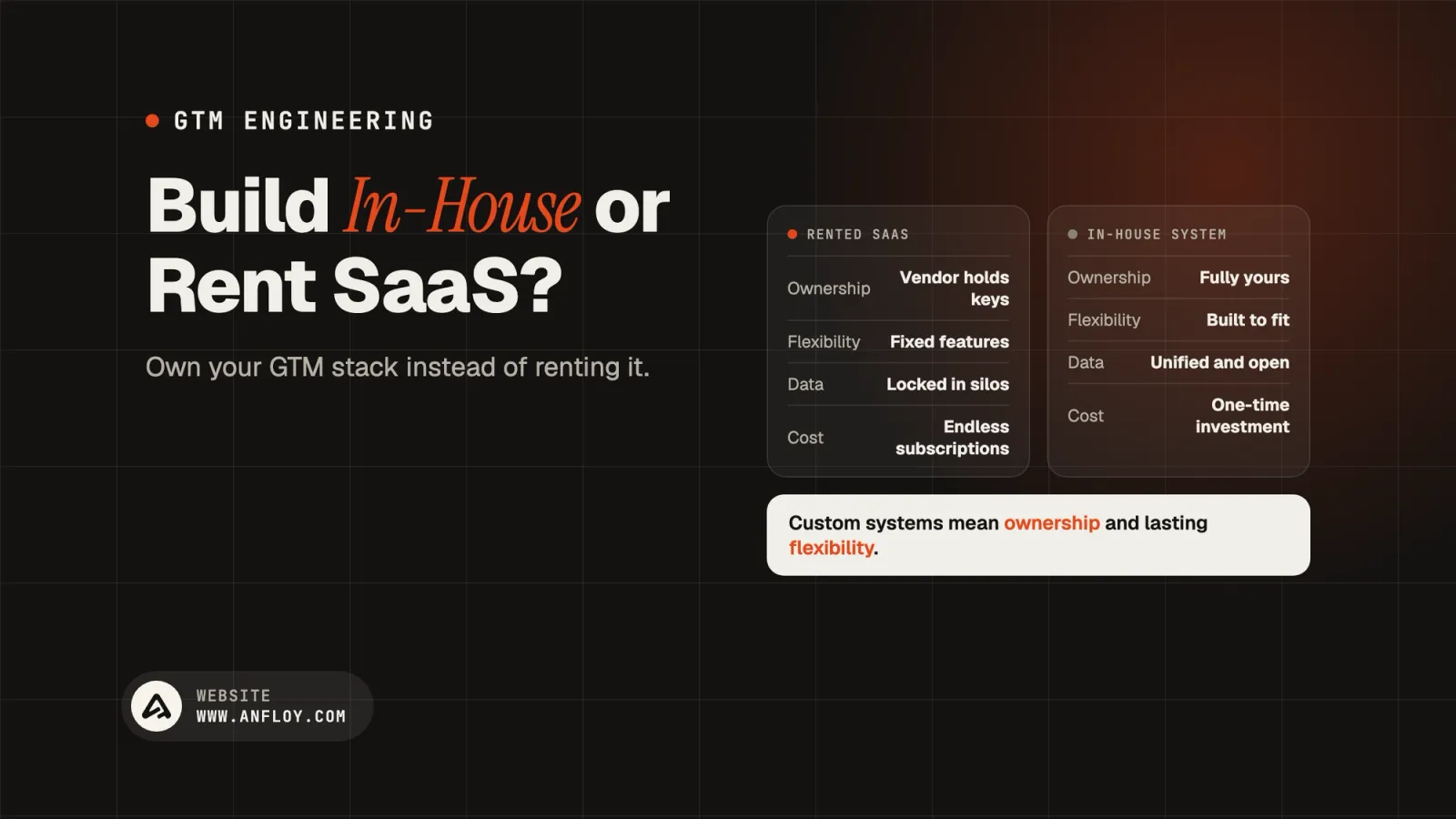
| Factor | SaaS GTM | In-House GTM |
|---|---|---|
| Ownership | Vendor | Company |
| Customization | Limited | Unlimited |
| Data Control | Shared | Complete |
| AI Integration | Vendor dependent | Fully customizable |
| Costs | Recurring | Upfront + maintenance |
| Vendor Lock-In | High | None |
| Scalability | Limited by pricing | Business controlled |
| Competitive Advantage | Shared | Proprietary |
There is no universal answer.
The right decision depends on:
- company size
- GTM complexity
- revenue goals
- internal capabilities
- long-term strategy
However, the balance is changing.
AI has significantly reduced the cost of building custom software.
Why companies are building In-house GTM systems?
Organizations building internal GTM infrastructure typically cite four primary reasons.
Ownership
When you build internally, you own:
- the code
- the workflows
- the data
- the integrations
- the operational logic
Your GTM system becomes an asset rather than an expense.
Flexibility
Internal systems adapt to your business rather than forcing your business to adapt to the software.
Examples include:
- custom lead scoring
- proprietary qualification models
- unique approval workflows
- specialized reporting
Better intelligence
Modern GTM systems increasingly depend on:
- Company Intelligence
- Revenue Intelligence
- AI Agents
- buying signals
- knowledge retrieval
Building internally allows businesses to create intelligence layers unavailable in traditional SaaS products.
Long-term economics
Although building software requires an upfront investment, ownership frequently becomes more economical over a multi-year period.
For many businesses, the question isn't:
"Can we afford to build?"
It's:
"How long can we afford not to own this capability?"
AI has changed the economics of building software
For decades, building internal software was considered expensive, slow, and resource-intensive.
Companies needed:
- large engineering teams
- dedicated product managers
- lengthy development cycles
- significant infrastructure investments
As a result, most organizations chose to buy software instead of building it.
Artificial intelligence is changing that equation.
Modern development tools powered by AI have dramatically reduced the time required to build production-ready applications.
Teams now use AI-assisted development platforms to:
- generate code
- create interfaces
- write tests
- document APIs
- identify bugs
- accelerate deployment
What once took years can now often be accomplished in months.
This doesn't eliminate the need for engineering expertise.
It simply changes the economics.
Businesses can now build highly customized GTM systems without maintaining massive development teams.
More importantly, AI enables organizations to create systems specifically designed around their competitive advantages rather than adapting to generalized software products.
Building an AI-powered GTM system
Modern GTM infrastructure looks very different from the traditional SaaS stack.
Instead of stitching together multiple tools, organizations are beginning to build centralized intelligence platforms.
A typical architecture looks like this:
Company AI Brain
       ↓
Company Intelligence
       ↓
CRM Layer
       ↓
Lead Qualification
       ↓
Outbound Engine
       ↓
Revenue Intelligence
       ↓
Customer Success
Let's examine each layer.
Company AI brain
Acts as the organization's centralized knowledge layer.
It stores:
- customer history
- sales playbooks
- pricing information
- internal documentation
- operational policies
- support resources
Every AI agent retrieves information from this shared knowledge system.
Company intelligence
Continuously monitors:
- funding announcements
- hiring activity
- technology adoption
- leadership changes
- market expansion
This intelligence enables revenue teams to identify opportunities earlier.
CRM layer
Maintains:
- account information
- contact records
- pipeline status
- customer interactions
AI continuously enriches and validates this data.
Lead qualification
Specialized AI agents score opportunities based on:
- ICP fit
- buying signals
- engagement activity
- historical conversion patterns
Outbound engine
Coordinates:
- email generation
- LinkedIn outreach
- follow-ups
- personalization
- sequence management
Revenue intelligence
Provides:
- forecasting
- pipeline visibility
- opportunity scoring
- performance analysis
Together, these layers create a unified GTM system rather than a collection of independent tools.
What should you build in-house?
Not every component of your GTM stack should be built internally.
Organizations should prioritize building capabilities that create competitive advantages.
Examples include:
Company intelligence
Your understanding of customers and markets is unique.
Owning this capability creates a long-term advantage.
Revenue intelligence
Custom forecasting and pipeline analysis frequently outperform generic dashboards.
Company AI brain
Internal knowledge systems become increasingly valuable as organizations grow.
AI agents
Specialized agents designed around your workflows deliver significantly more value than generalized assistants.
GTM workflows
Custom workflows ensure AI operates according to your business logic rather than vendor assumptions.
Internal operations
Processes such as onboarding, approvals, and reporting are often excellent candidates for internal automation.
In general:
Build the capabilities that differentiate your business.
What should you continue buying?
Ownership doesn't mean building everything.
Some infrastructure is better purchased than maintained internally.
Examples include:
Cloud infrastructure
Platforms such as:
- Amazon Web Services (AWS)
- Google Cloud
- Microsoft Azure
provide reliable and scalable infrastructure.
Email infrastructure
Services for:
- email delivery
- authentication
- reputation management
are typically more efficient to buy.
Payment Processing
Payment platforms have significant compliance requirements and are rarely worth rebuilding.
Communication platforms
Businesses should continue leveraging established tools for:
- video conferencing
- messaging
- collaboration
The goal isn't to eliminate SaaS.
It's to strategically decide which capabilities deserve ownership.
Get a free GTM infrastructure audit
Most businesses don't need to replace their entire GTM stack.
They need to understand which capabilities should remain rented and which should become owned infrastructure.
Our Free GTM Infrastructure Audit helps identify:
- opportunities for ownership
- GTM bottlenecks
- AI implementation priorities
- revenue intelligence gaps
- workflow automation opportunities
- long-term cost considerations
You'll receive practical recommendations tailored to your business rather than generic software advice.
Get Your Free AI Audit
How Anfloy builds in-house GTM systems?
At Anfloy, we believe businesses should own the systems that create their competitive advantages.
Every GTM implementation follows a structured methodology designed around ownership, intelligence, and scalability.
Step 1: Discovery
We begin by understanding:
- business objectives
- revenue goals
- customer journey
- GTM workflows
- operational bottlenecks
- existing technology stack
This ensures every system supports measurable business outcomes.
Step 2: Build the company AI brain
Every GTM platform starts with knowledge.
We centralize:
- CRM data
- customer history
- pricing documentation
- sales playbooks
- operational knowledge
- support resources
Using Retrieval-Augmented Generation (RAG), vector embeddings, and semantic search, every AI system retrieves trusted business information.
Step 3: Build GTM intelligence
We create intelligence layers that continuously monitor:
- market activity
- buying signals
- account changes
- pipeline health
- customer engagement
This transforms static data into actionable insights.
Step 4: Deploy agentic systems
Rather than building one large assistant, we design specialized AI agents responsible for:
- Company Intelligence
- CRM enrichment
- Lead Qualification
- Revenue Intelligence
- Customer Success
These agents collaborate through AI orchestration while remaining independently scalable.
Step 5: Implement AI orchestration
The orchestration layer coordinates:
- workflows
- agent communication
- approvals
- monitoring
- reporting
This creates a connected GTM ecosystem rather than isolated automations.
Step 6: Deploy infrastructure you own
Every solution is deployed directly on infrastructure owned by the client.
You own:
- the code
- the workflows
- the Company AI Brain
- the AI agents
- the integrations
- the operational data
There is no vendor lock-in.
Your GTM infrastructure becomes a long-term business asset.
What is the future of GTM infrastructure?
The future of GTM isn't more software.
It's more ownership.
Over the next decade, businesses will increasingly move toward:
Autonomous GTM
AI systems capable of:
- monitoring buying signals
- qualifying opportunities
- generating outreach
- updating CRM records
- recommending next actions
Multi-agent revenue teams
Revenue organizations will deploy specialized AI coworkers across:
- sales
- RevOps
- customer success
- marketing
- account management
Company-owned intelligence
Businesses will increasingly own:
- customer intelligence
- knowledge systems
- revenue analytics
- AI infrastructure
Ownership will become a competitive advantage.
AI operating systems
Future GTM teams will operate through unified AI platforms combining:
- Company AI Brains
- Agentic Systems
- Revenue Intelligence
- AI Orchestration
- Autonomous Workflows
Organizations that invest in these capabilities today will be better positioned for the next generation of enterprise AI.
Conclusion
SaaS products transformed how businesses adopt technology.
They remain valuable and will continue to play an important role in modern organizations.
However, AI is changing the economics of software development
Capabilities that were once prohibitively expensive to build are now increasingly accessible.
As a result, businesses are beginning to ask a different question.
Not:
"Which GTM tools should we buy?"
But:
"Which GTM capabilities should we own?"
For many organizations, the answer includes Company Intelligence, Revenue Intelligence, AI Agents, GTM workflows, and centralized knowledge systems.
At Anfloy, we help businesses make that transition by designing AI-powered GTM systems built around ownership, intelligence, and long-term scalability.
Because in a world increasingly powered by AI, your greatest competitive advantage shouldn't be rented.
It should be owned.
Build your own AI-powered GTM system
From Company AI Brains and Revenue Intelligence to Agentic Systems and AI Orchestration, Anfloy helps businesses design GTM infrastructure they fully own.
Book a Strategy Call
Frequently Asked Questions
Is it cheaper to build GTM software?
Not always initially. However, for many growing organizations, owning critical GTM capabilities becomes more economical over several years compared to recurring subscription costs.
When should companies stop using SaaS?
Most businesses shouldn't eliminate SaaS entirely. Instead, they should evaluate which capabilities create strategic advantages and consider owning those components.
Can small businesses build GTM systems?
Yes. AI-assisted development has significantly reduced the cost and complexity of building internal software.
What are the risks of vendor lock-in?
Vendor lock-in can limit customization, increase costs, restrict access to data, and create dependencies on external product roadmaps.

Let's build
what your
company needs.
Drop your email. We'll send The Custom Agent Blueprint on what we'd build first for a company like yours, before you ever take a meeting.